Ottoman furniture can give you somewhere to rest your feet, offer an extra seat, hide spare blankets, or hold a tray beside the sofa. Some pieces handle several of these jobs, while others work best with one clear purpose. The right choice depends on how you use your room and how much space you can comfortably give it.
Appearance matters, but size, shape, upholstery, and construction affect how useful an ottoman feels every day. A deeply cushioned top might be comfortable under your legs but awkward for a tray. A large storage design may hold plenty of belongings yet leave too little space to walk around it.
Start by deciding what you need most. Then consider how the ottoman will sit alongside your existing furniture, what care its surface requires, and whether it will be easy to move. These practical details help you choose a piece that feels like a natural part of the room.
What Makes an Ottoman Different From a Pouf or Footstool?
An ottoman is usually a padded piece of furniture without a back or arms. Many designs have a firm internal frame, an upholstered top, and either visible legs or a base that sits close to the floor. Depending on its construction, an ottoman may work as a footrest, occasional seat, or central surface.
A pouf is generally softer and less structured. It often has a fabric or leather cover filled with material that gives under pressure. Poufs can be convenient for relaxed seating arrangements, although their shape and support vary considerably.
A footstool is primarily intended to support your feet. It is often smaller than an ottoman and may have a padded or hard top. However, retailers sometimes use these names interchangeably, so the label alone tells you little about strength or comfort.
Focus on the product’s dimensions, firmness, and approved uses. A piece described as an ottoman is not automatically suitable for adult seating, and a soft pouf may not provide the steady support you want beneath your legs.
Start With the Job Your Ottoman Needs to Do
Think about the activity that will bring you to the ottoman most often. If you want to stretch out while reading, prioritize a comfortable height and enough surface area to support your legs. The edge should feel comfortable beneath your calves, without a hard frame pressing through the padding.
For extra seating, stability and weight capacity become more important. Look for a design explicitly intended to support a seated person. A very low or deeply cushioned ottoman may be less comfortable for guests who find low seating difficult to use.
If you want a coffee table alternative, choose a broad, reasonably firm top. A suitable tray can create a more usable surface for small items, but it cannot make a soft, uneven cushion fully stable. Consider keeping drinks on a nearby side table if the ottoman moves or compresses easily.
Storage is another useful role, particularly when blankets or small household items regularly collect around the sofa. Check that the compartment fits what you actually plan to store. An ottoman that performs two jobs well can be more useful than one that promises several functions but makes each awkward.
Ottoman Styles and Where They Work Best
A standard upholstered ottoman offers straightforward flexibility. Without a storage compartment or moving lid, it can be easy to position in front of a chair or move between seats. Designs with visible legs tend to show more floor beneath them, while solid bases create a heavier visual presence.
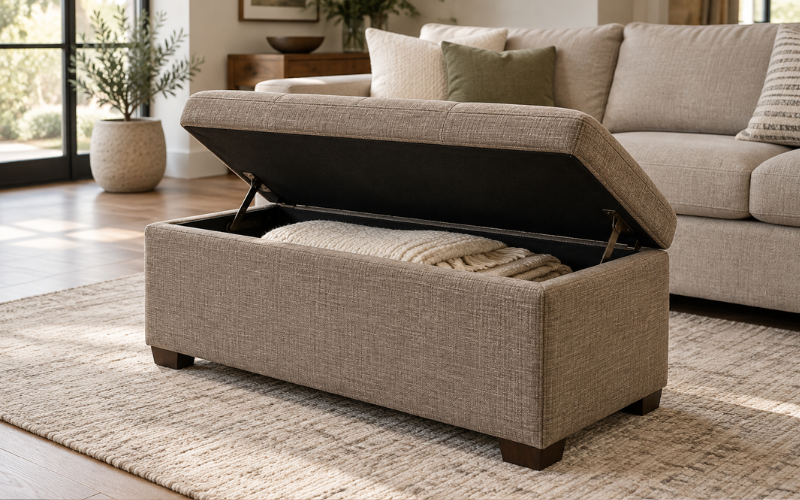
Storage ottomans come with hinged tops, removable lids, or occasionally drawers. A hinged lid stays attached, but it needs room to open. A removable top gives access from different sides, although you need somewhere to put it while reaching inside.
Cocktail ottomans are generally larger pieces intended to sit in the middle of a seating arrangement. Their generous tops can accommodate a tray while leaving some padded space available. They suit rooms where an upholstered centerpiece feels more useful than a conventional coffee table.
Ottoman benches have a longer, narrower shape that can work at the foot of a bed or along a wall. Matching ottomans, meanwhile, are designed to coordinate with particular chairs or sofas. Some sectional versions can extend the seating into a chaise-like arrangement, but check whether they connect securely or simply sit beside the sofa.
Choose a Size and Shape That Fits Your Furniture
Measure the space before choosing a size. Include the sofa or chair, nearby tables, and the routes people take through the room. Product photographs rarely show whether an ottoman will fit comfortably into your particular arrangement.
For a footrest, a useful starting point is a top close to the seat height or slightly lower. Comfort also depends on how much the chair and ottoman cushions compress. If possible, try them together rather than comparing their listed heights alone.
Width and depth should reflect the intended use. One person relaxing in an armchair needs less surface area than two people sharing a footrest in front of a sofa. A large central ottoman should still leave nearby seats accessible.
Round shapes remove projecting corners and can suit arrangements with movement on several sides. Rectangular ottomans often follow the lines of a sofa, while square designs can work within more evenly proportioned seating groups.
Mark the footprint on the floor with painter’s tape suitable for your flooring. Walk around it, open nearby drawers, and imagine reaching the storage compartment. Leave enough room for normal movement, including any mobility aids used in the household. A layout that looks balanced should also feel easy to navigate.
Compare Upholstery for Comfort and Everyday Care
Because an ottoman often touches bare legs, feet, clothing, and sometimes pets, its upholstery deserves careful attention. Feel a sample if possible. A textured fabric that looks attractive online may feel rough against your skin, while a very smooth surface may be more comfortable for regular use.
Look at the weave as well as the color. Raised loops and loose threads may catch on claws or jewelry. Plush fabrics can show changes in direction or pressure marks, which may be part of their normal appearance rather than damage.
Leather varies according to its finish. Some types develop visible marks and changes in tone, while others have a more protective surface. Faux leather can offer a similar appearance, but its care requirements and resistance to wear depend on the material. Neither label guarantees easy maintenance.
Follow the care instructions for the specific upholstery. A removable cover is not necessarily machine-washable, and a fabric marketed as stain-resistant still needs appropriate cleaning.
For color, consider the sofa, rug, and surrounding textiles together. A patterned ottoman can add interest beside plain seating, while a quieter fabric may work better in a room that already includes several patterns. Choose a finish you can comfortably maintain as well as enjoy looking at.
Look Beyond the Upholstery at Construction
The outside of an ottoman gives only part of the picture. A well-padded top can hide a weak frame, so look for clear information about the materials and assembly. If you can inspect the piece in person, check that it sits evenly and does not rock on a level floor.
Legs should attach securely, and the frame should feel steady during its intended use. When shopping online, examine close-up photographs and assembly instructions where available. Descriptions such as “sturdy” are less helpful than specific details about construction and permitted loads.
Cushion firmness should match the job. Softer padding may feel pleasant as a footrest, while a firmer top generally provides more support for sitting or holding a tray. Ask about the filling and whether the cushion or cover can be replaced if that matters to you.
For storage designs, inspect the hinges and lid supports. The top should open predictably and stay supported as intended. Check the internal measurements, since thick walls and hinge hardware can reduce usable space. If children will use the room, pay particular attention to the lid’s closing action and the manufacturer’s safety instructions.
Place an Ottoman Where It Makes the Room Easier to Use
In front of a sofa, position the ottoman close enough to reach comfortably without forcing your legs into an awkward stretch. At the same time, make sure you can sit down and stand up without squeezing through a narrow gap. Adjusting its position by a few inches can make a noticeable difference.
Beside an armchair, align it with the direction you naturally sit. A chair angled toward a window may need its ottoman at the same angle. Follow the seating arrangement rather than automatically lining every piece up with the walls.
At the foot of a bed, a bench-style ottoman can provide a place to sit while dressing. Check that bedding does not obstruct a storage lid and that the ottoman leaves a comfortable route around the bed.
In a compact room, a smaller piece may move between footrest and guest-seat duties. Consider its weight and whether it has a practical place to stay when moved aside. An ottoman that must be dragged into a doorway whenever someone visits may create more inconvenience than flexibility.
Style an Ottoman Without Losing Its Function
An ottoman does not need to match the sofa exactly. It can connect with the room through a shared color, similar leg finish, or related texture. For example, a warm neutral ottoman might pick up a shade in the rug while standing apart from a darker sofa.
Keep its main purpose visible in your styling choices. If you regularly put your feet up, covering the entire top with books and decorative objects creates a task every time you want to relax. One easily moved tray may be enough.
Choose a tray that rests securely within the edges of the ottoman. Test whether it rocks or tips when the cushion compresses nearby. Handles can make removal easier, but the surface beneath still needs to be sufficiently firm and level.
Avoid placing heavy or fragile arrangements on a lid that opens frequently. Storage should remain convenient, and a seating ottoman should have space available when needed. The most practical styling supports the furniture’s everyday role without making it feel unfinished when the accessories are removed.
What to Check Before Buying Ottoman Furniture
Before ordering ottoman furniture, compare the full external measurements with your marked floor space. Check whether the dimensions include projecting legs, handles, or other details. For storage pieces, find the internal dimensions and the clearance needed to raise or remove the lid.
Request an upholstery sample when possible. View it beside your sofa and flooring in both daylight and evening light. This helps you judge color and texture more accurately than a product image viewed on a screen.
Read the care guidance before committing. Consider whether the recommended cleaning method fits your household and whether replacement covers are available. If seating is part of your plan, confirm that the manufacturer permits it and provides an appropriate weight limit.
Delivery details also matter. Check doorways, stairs, and tight turns, along with whether the legs arrive attached. Review assembly requirements and find out whether delivery includes bringing the item into the room.
Finally, read the return terms, including collection charges and any restrictions on custom upholstery. A slightly cheaper ottoman may be less appealing if returning an uncomfortable or poorly fitting piece would be difficult.
Conclusion
The best ottoman furniture suits a clear purpose and fits comfortably around the furniture you already own. Size, height, cushioning, and construction shape how useful it will be, while upholstery determines much of its comfort and care.
Start with the job you need it to perform, measure the available space, and compare the details that support that use. Whether you choose a compact footrest, a storage bench, or a large central ottoman, aim for a piece that makes daily life easier without crowding the room.
FAQs
1. Can all ottomans be used as seats?
No. Some ottomans are designed only as footrests or lightweight storage pieces. Check the manufacturer’s stated uses and weight limit before using one as a seat. A padded top does not establish that the frame can support a person. For regular occasional seating, choose a stable design with a comfortable height and enough firmness to make sitting down and standing up manageable.
2. Should an ottoman be the same height as the sofa?
For use as a footrest, an ottoman close to the sofa’s seat height or slightly lower is a practical starting point. However, the right fit depends on your comfort and how much both cushions sink under pressure. Compare the ottoman with the seat cushion, not the sofa arms or back. Trying the two together is more useful than relying on a height measurement alone.
3. Can an ottoman replace a coffee table?
An ottoman can replace a coffee table when you value a padded footrest or occasional seating alongside a surface for small items. A firm top and stable tray make it more practical. If you regularly serve drinks, eat, or play board games in that spot, a conventional table may suit those activities better. A nearby side table can also provide a dependable surface for drinks.
4. Is a storage ottoman useful in a small room?
A storage ottoman can be useful when it replaces another item or holds belongings that otherwise lack a home. Measure the compartment and check that the lid opens easily within the room. Its footprint still matters: extra storage is less helpful if the piece blocks a walkway. Choose a size that balances usable storage with comfortable movement around the surrounding furniture.
5. Does an ottoman need to match the sofa?
No. Matching can create a coordinated appearance, but a different upholstery or shape can work equally well. Connect the pieces through one or two details, such as color undertones, fabric texture, or leg finish. Consider the rug and chairs too, so the ottoman relates to the whole room. Its proportions and practical fit are more important than an exact fabric match.