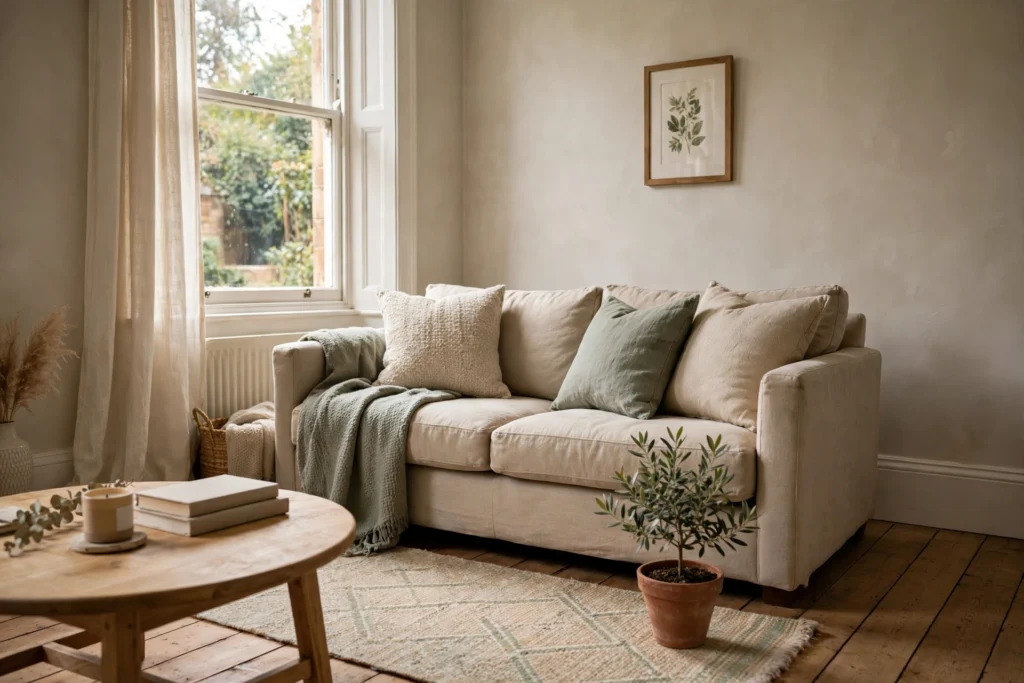
A good set of sofa cushions should do three jobs at once. They should support you when you sit, make the sofa look finished, and be easy enough to look after in a busy home. Start with a 45 x 45 cm square cushion for most two- and three-seater sofas, choose an insert about 5 cm larger than the cover, and pick foam or fiber when you want support with less daily care, or feather when you want a softer, sink-in feel and do not mind regular plumping. Always check the care label before you buy, because a beautiful cover that cannot be cleaned in a way that suits your home will soon look tired.
That short answer covers most homes. The rest of this guide helps you match the details to your sofa, your room, and the way you actually live. A cushion that suits a quiet reading corner may not suit a family sofa used every evening. A pale velvet cushion may look wonderful in a calm adult living room and be a poor choice where muddy paws, sticky fingers, or frequent spills are part of daily life.
What Job Should the Cushion Do?
Before you look at colors, decide what the cushion must do. This one choice makes the rest easier.
A seat cushion must support weight, hold its shape, and help you sit without sinking too far. A back cushion should support your back and fill the gap between you and the sofa frame. A scatter cushion is mainly for comfort, color, and style, although it can also support your lower back or your arm when you lean to one side.
Think about who will use the sofa most. Children may climb, jump, and spill. Older family members may need a firmer seat and a cushion that does not slide forward. Someone who reads for a long time may want a lumbar cushion, which is a rectangular cushion that supports the lower back. Someone who naps may want a soft, larger cushion to lean against.
Also think about how often the sofa is used. A sofa in a formal sitting room that is used at weekends needs a different level of strength from a sofa that is used for homework, television, meals, and guests. Daily use calls for stronger fabric, a firmer fill, and covers that are easy to clean.
A useful test is simple. Sit in your usual way for several minutes. Notice where your back needs support, whether your feet reach the floor, and whether the seat edge presses behind your knees. A cushion should help your usual position, not force you into a new one.
Size and Shape: Start With Measurements
Cushions look wrong most often because the size is wrong. A cushion that is too small can look lost on a large sofa. A cushion that is too large can push you forward, cover the arm, or make the seat feel shallow.
In the UK, cushion sizes are usually given in centimeters. The most common sofa cushion size is 45 x 45 cm, which is about 18 x 18 inches. The 50 x 50 cm size is also common and suits larger sofas. Smaller 40 x 40 cm cushions suit compact sofas and layering in front of larger cushions.
Measure your sofa before you shop. Note the seat width, seat depth, and back height. A deep seat can take a larger cushion without pushing you forward. A shallow seat needs a slimmer cushion, or you will lose leg room. A low back needs a cushion that does not rise too far above it, or the sofa can look top-heavy.
Shapes matter as much as size. Square cushions are the main building block. Rectangular lumbar cushions, usually around 30 x 50 cm or 40 x 60 cm, are useful for lower-back support and for layering in front of squares. Round cushions, usually 35 to 45 cm across, soften straight lines. Bolster cushions, which are long cylinders, can support an arm or fill a corner, but they roll easily, so they suit a settled arrangement rather than a busy family sofa.
| Sofa type | Useful starting sizes | Usual number |
|---|---|---|
| Small sofa or loveseat | 40 x 40 cm or 45 x 45 cm | 2 to 3 |
| Three-seater sofa | 45 x 45 cm, with 50 x 50 cm at the ends if the sofa is deep | 4 to 5 |
| Corner or sectional sofa | 50 x 50 cm at the ends, 45 x 45 cm and lumbar cushions in the middle | 5 to 7 |
| Armchair | One 45 x 45 cm cushion, or one lumbar cushion | 1 |
These are starting points, not rules. A narrow room, a low sofa, or a very firm seat may need fewer or smaller cushions. If you are unsure, start with fewer cushions. You can add one later. It is harder to make a crowded sofa feel calm.
The Insert Rule That Stops Flat Cushions
Many flat cushions are not faulty. The insert is simply the same size as the cover.
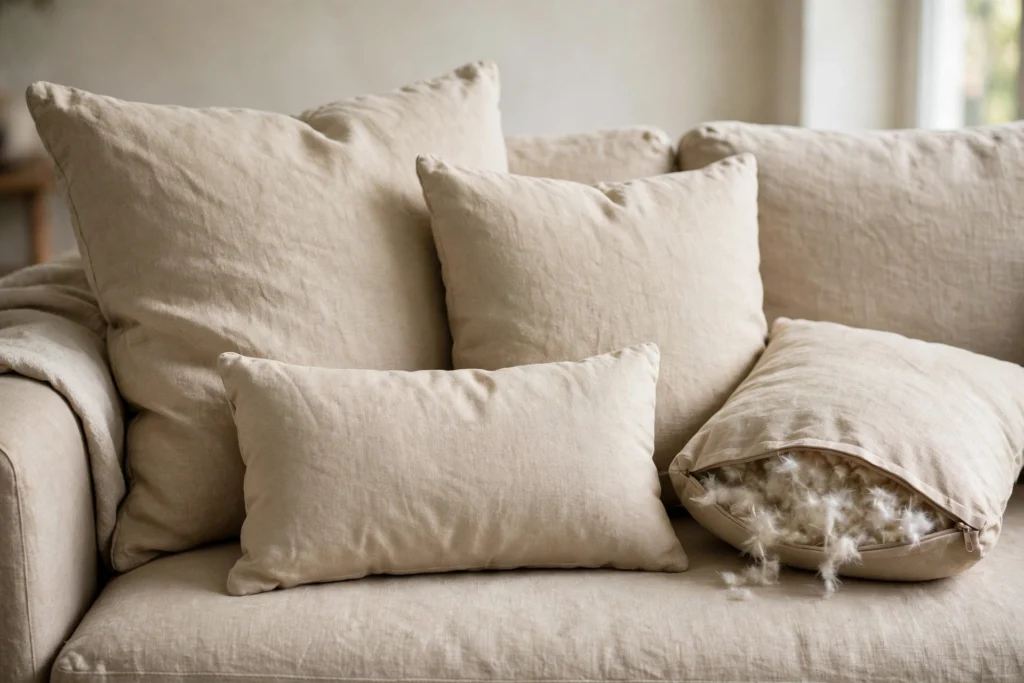
For a plump look, choose an insert about 5 cm larger than the cover. A 45 x 45 cm cover, for example, usually looks better with a 50 x 50 cm insert. The extra fill pushes the corners out and keeps the cover taut. A same-size insert often leaves soft corners and a slack front.
Check whether you are buying a cover only, a ready-filled cushion, or a separate insert. A cover only makes sense if you already have good inserts, or you want to choose your own fill and firmness. A ready-filled cushion is simpler when you are starting from scratch. A separate insert gives you more control, but you must get the size right.
Also check the insert casing. A strong inner casing with a good zip or closure keeps loose filling in place. A thin casing can let feather quills poke through, or let fiber clump in one corner. If you can, feel the insert through the cover. It should feel even, with no hard lumps or empty corners.
When you replace an insert in an old cover, measure the cover seam to seam, not the flattened insert. An old insert may have lost height and width. Measuring the cover gives you a truer size. If the cover has stretched, a slightly larger insert may still help, but a very stretched cover may need repair or replacement.
Fillings Compared: Foam, Fiber, Feather and Hybrids
Filling decides how a cushion feels, how much care it needs, and how long it keeps its shape. There is no filling that is best for everyone. The right choice depends on support, softness, allergies, and how much plumping you are willing to do.
Foam gives firm support and holds its shape well. High-density foam is springy and can keep its shape through heavy daily use. It needs less plumping than loose fillings. It can feel hard if it is too firm for your taste, and low-density foam may lose support sooner. Foam is often the better choice for seat cushions that must support weight all day.
Fiber, usually polyester fiber, is soft, light, and feather-free. It gives a plump, full look and is often a good choice for back cushions and scatter cushions. It is usually more affordable than feather. It does need regular plumping, especially in seat cushions, because the fibers settle with use. Fiber cushions will not hold a fixed, sharp shape in the same way as foam.
Feather gives a soft, heavy, traditional feel with natural movement. Duck and goose feather are most common. Feather cushions sink in nicely and can be shaped with a firm pat, which is sometimes called the designer chop. They need the most care. They must be plumped, turned, and dressed often to keep the filling even. They are not a fit-and-forget choice.
Feather and down is softer and lighter than feather alone. Down is the soft under-plumage, and it adds fullness. This blend is often chosen for a premium, relaxed look. It still needs regular care, and it is usually the most costly of the loose fillings.
Hybrid fillings try to combine strengths. A foam core with a fiber wrap gives firm support with a softer outer feel. A foam core with a feather wrap gives stability with a plush surface. These hybrids can suit a seat cushion that must support you but should not feel hard at the edges. Ask what is inside, because the word hybrid alone does not tell you the mix.
Crumbed foam is loose foam in small pieces. It gives a soft but slightly more resilient feel than fiber, and it suits scatter cushions where a loose fill is wanted but a foam-based feel is preferred.
| Filling | Feel | Support | Care | Suits |
|---|---|---|---|---|
| Foam | Firm, steady | High | Low; turn and rotate | Daily seat cushions |
| Fiber | Soft, plump, light | Medium | Regular plumping | Back and scatter cushions |
| Feather | Soft, heavy, sink-in | Low to medium | Frequent plumping and dressing | Relaxed, styled living rooms |
| Feather and down | Very soft, full | Low to medium | Frequent plumping | Premium scatter and back cushions |
| Foam with fiber or feather wrap | Firm center, soft surface | High | Moderate | Seat cushions that need comfort and shape |
If you have a feather allergy, or asthma that is affected by dust, fiber or foam is often the safer starting point. Feather fillings are natural, but they are not the right choice for every household. Check the product details for allergy guidance, and wash or air covers as the label allows. No filling can promise that it will suit every person with an allergy, so personal comfort and medical advice matter more than a general label.
Seat Cushions, Back Cushions and Scatter Cushions Are Not the Same
It helps to treat these as three different products, even when they look similar.
Seat cushions carry weight. They need a filling that recovers after you stand up. Foam, or foam with a wrap, is often the most reliable choice here. A loose fiber or feather seat cushion can feel lovely at first, but it may need daily dressing to stay even. If your seat cushion is fixed to the sofa and cannot be removed, ask how it is filled and whether the cover can be cleaned. A fixed cushion that flattens is harder to fix than a loose one.
Back cushions should fill the space behind you without pushing you too far forward. A cushion that is too thick can make a shallow sofa feel cramped. A cushion that is too soft can leave a gap at your lower back. Try the cushion with your back against it. You should feel support at your lower back and shoulders, without straining to reach the armrest.
Scatter cushions are the easiest place to add color and texture. They do not need to carry full body weight, so you can choose a softer fill here. Use them to test a new color or fabric without changing the whole sofa. If a scatter cushion is uncomfortable, move it. It should add comfort, not get in the way.
When you buy a sofa, ask whether the seat, back, and scatter cushions use the same filling. They often do not. A sofa with a firm foam seat and soft fiber backs can feel balanced. A sofa with soft feather throughout can feel luxurious but may need more care. Knowing the mix helps you plan cleaning and replacement later. For help judging the sofa itself, the guide to sofa size, comfort, materials and style explains why seat depth, back height, and cushion support should be checked together, and a comparison of sofa and loveseat sizes can help if you are still deciding how much seating you need.
Fabric and Covers: What Will Survive Daily Life?
Fabric affects comfort, cleaning, fading, and how the cushion feels against skin. A fabric that looks perfect in a shop may not suit a sunny room, a home with pets, or a sofa near a radiator.
Cotton and linen feel breathable and natural. They suit a relaxed, casual room. They can crease, and some linen blends may need gentle washing and air drying. Linen can also fade in strong sun, so check the care guidance if your sofa sits in a bright bay window.
Velvet feels soft and rich, and it adds depth to a plain sofa. It can show pressure marks and shading where the pile is pressed. This is often a normal feature of velvet, not a fault. Velvet usually needs gentle vacuuming and soft brushing in the direction of the pile. It is not always machine washable, so check the label.
Bouclé, chenille, and knitted fabrics add texture and warmth. They can catch pet claws, jewelry, and rough Velcro, so they need more care in a busy home. A tight weave is usually easier to keep clean than a loose, looped weave.
Performance fabrics, including some treated cotton and synthetic blends, are made to resist stains and wear. They can be a good choice for family rooms. They are not stain-proof. Spills should still be blotted quickly, and the care label still matters. Ask what treatment has been used, and whether it affects washing.
Leather and faux leather cushions are less common as scatter cushions, but they do exist. They need specialist care and should not be soaked. If you are unsure, choose a fabric cushion for everyday use and keep leather for a fixed seat where the maker’s guidance is clear.
Removable covers are a major practical advantage. A zip should run smoothly and sit in a neat seam. A cover that is hard to remove will be cleaned less often. A fixed cover may look neat, but it limits your options. Ask whether the cover is machine washable, hand wash only, or dry clean only, and whether all covers should be washed together to avoid color differences.
Also check the seams. Strong, even stitching, neat piping, and a firm zip are signs of careful making. Loose threads, uneven seams, or a zip that catches may become worse with washing. A cushion that will be used daily needs stronger seams than a cushion that will sit on a guest bed.
Color, Pattern and Texture Without Clutter
Color should connect the sofa to the room, not fight it. Start with the sofa color, wall color, flooring, and any large rug. Then choose cushions that relate to those surfaces.
A gray sofa can take many colors, but the undertone matters. A blue-gray sofa may look cooler with navy and cream, while a warm gray may suit rust, olive, and warm cream. A beige sofa can look pink, yellow, or green beside different walls, so test cushions in daylight and evening light. The guide to outdated couch colors and simple refresh ideas shows how undertones, lighting, and surrounding finishes change the way a sofa color reads, which is useful before you add a strong new cushion color.
A useful method is to choose one main color, one supporting color, and one texture. For example, a navy sofa with cream linen cushions, one mustard lumbar cushion, and a knitted throw gives contrast without chaos. A beige sofa with sage, cream, and a soft check pattern can feel calm and layered.
Pattern needs scale. Mix one larger pattern with one smaller pattern and plain cushions. Two large, busy patterns at the same size can compete. A stripe, a small geometric, and a plain velvet often work well together. Keep the colors in the same family, even if the patterns differ.
Texture can do the work that color cannot. Velvet beside linen, a chunky knit beside smooth cotton, or a woven cushion beside a plain sofa adds interest without adding more colors. This is especially useful in a neutral room. A room with only one color can still feel rich when textures vary.
Avoid matching everything exactly. Cushions do not need to match the curtains, rug, and throw perfectly. They should share a color family or a repeated tone. Exact matching can make a room feel like a display, rather than a lived-in space.
How Many Cushions, and How to Arrange Them
Too many cushions can make a sofa hard to use. Too few can make it look bare. The right number depends on sofa size, seat depth, and how you sit.
A common guide is two to four cushions on a two-seater, four to six on a three-seater, and six to eight on a corner sofa. Odd numbers often feel more relaxed than perfect symmetry. Three cushions on a two-seater and five on a larger sofa are useful starting points.
The 2-2-1 rule is one well-known arrangement for a three-seater. Place two large cushions at the ends, two slightly smaller cushions next to them, and one statement cushion in the center. This creates layers without hiding the sofa. It works best when the large cushions are plain, the middle cushions share a color, and the central cushion adds pattern or texture.
For a corner sofa, work by section. Place larger cushions at the outer ends and in the corner, then add smaller cushions toward the center. Keep the corner usable. A cushion that blocks the corner seat will be moved every time someone sits there.
For a small living room, keep the arrangement neat. Use fewer, slimmer cushions, and leave space to sit. A large cushion on a small sofa can look generous in a photograph and feel awkward in use. If the room is small, a lumbar cushion in front of a square cushion gives support without taking up the whole seat.
Arrange cushions from back to front. Place the largest cushions at the back, against the sofa back. Add medium cushions in front of them. Place a lumbar or small accent cushion at the front. Step back and check the shape. The cushions should look layered, not piled. If you must move cushions every time you sit, you have too many, or they are too large.
Comfort Checks You Can Do Before You Buy
A cushion can look right and feel wrong. Use these checks in a shop, or in the first days at home if returns are allowed.
Sit for several minutes, not just a few seconds. A foam cushion may feel firm at first and settle into a comfortable shape. A feather cushion may feel soft at first and flatten under your weight. Notice whether you sink evenly, or whether one side drops more than the other.
Lean back and check lower-back support. A lumbar cushion should fill the curve of your lower back without pushing your shoulders forward. If you feel a gap, try a thicker lumbar cushion or move the square cushion behind it.
Check the edges. A seat cushion with a weak front edge can make your legs feel unsupported. A back cushion with a soft top edge may fold forward. Press the center and the corners. The fill should feel even, with no hard board in the middle or empty corners.
Check stability. A cushion that slides forward every time you stand up will need constant adjustment. A non-slip base, a heavier fill, or a better fit in the sofa frame can help. If the cushion is much smaller than the seat, it may move more.
Check the zip and seams while the cushion is in your hands. Open and close the zip once. Look at the corners. A well-made cushion should keep its shape when you hold it by one corner, without the filling shifting to the other end.
If you buy online, read the returns policy before you order. Note the size, filling, fabric, and care instructions in writing. When the cushion arrives, test it in daylight and evening light, and sit on it in your usual way. A cushion that only looks good in a product photograph is not a good buy.
Budget: What Should You Expect to Pay?
Cushion prices vary widely, and the headline price does not always include the same things. A cover only, a ready-filled cushion, and a made-to-measure insert can have very different prices. Always compare like with like.
As a planning example, not a current price promise, a single filled scatter cushion in the UK is often listed in the low tens of pounds, while a feather-filled 45 x 45 cm cushion can cost more than a basic fiber-filled one. One comparison listing seen in October 2026 showed a Dunelm feather-filled jungle-print cushion at £22. That is one example at one time, not a market average. Prices change with fabric, size, filling, and retailer, so check the listing on the day you buy.
Made-to-measure replacement inserts usually cost more than a standard scatter cushion, because they are cut to size and use a chosen filling. A range quoted by one UK retailer in search results was £25 to £150 or more per cushion, depending on size and filling. Treat that as a broad planning range, not a quote. Ask what is included: insert only, cover only, delivery, and any fitting help.
A useful way to judge value is cost per year of use. A low-cost cushion that flattens in a few months and must be replaced may cost more over time than a stronger cushion that keeps its shape. A removable, washable cover also adds value, because it can be cleaned and, in some cases, replaced without buying a new insert.
Set a budget for the whole arrangement, not just one cushion. Five cushions at a modest price can cost more than three better cushions that suit the sofa. Start with the cushions you need for comfort, then add one accent cushion for style. You can add more later, when you know how the first set wears.
Separate product cost from other costs. Delivery, professional cleaning, and replacement inserts are separate. If you plan to have cushions professionally cleaned, ask for a price before you buy a dry-clean-only fabric. A fabric that needs specialist care every few months may cost more over its life than a washable fabric that costs slightly more at first.
Care That Keeps Cushions Looking Good
Regular, gentle care matters more than occasional deep cleaning. Most cushions need plumping, turning, and vacuuming far more often than washing.
Plump loose-filled cushions every day if they are used daily. Hold the cushion by opposite corners, shake it gently, and pat it back into shape. Turn it over and rotate it so wear is even. For fiber-filled seat cushions, daily dressing helps the filling stay even. Feather cushions also need turning and dressing, because the filling settles and shifts with use.
Vacuum cushions weekly with an upholstery attachment, using gentle suction. Vacuum under the cushions too, where crumbs and dust collect. Avoid rough brushing, which can damage fibers. For velvet and chenille, brush softly in the direction of the pile. Pressure marks on velvet are often normal and can be eased by gentle brushing, not by soaking the fabric.
Wash only as the care label allows. Some covers are machine washable, some need hand washing, and some are dry clean only. Wash all covers from the same sofa at the same time when the label allows, to reduce color differences. Turn covers inside out, use a gentle cycle and a mild detergent, and avoid bleach unless the label clearly allows it. Do not tumble dry unless the label says you can. Air dry flat, away from direct heat, and reshape the cover while it is damp if the label permits.
Learn the common cleaning codes on upholstery labels. W usually means water-based cleaning is allowed. S means solvent-based cleaning only. WS means either water-based or solvent-based cleaning may be used. X means vacuum or light brushing only, with no water or solvent. These codes are a guide, not a substitute for the maker’s full instructions. If the label is unclear, ask the retailer or maker before you clean.
Deal with spills quickly. Blot, do not rub. Rubbing can spread a stain and damage the fabric surface. Use a clean, white, absorbent cloth. Remove solids with a blunt knife or spatula first. Test any cleaner on a hidden area if the maker allows it, and follow the product instructions. Oil and grease stains often need professional help, especially on velvet and other pile fabrics.
Keep cushions away from prolonged direct sunlight and strong heat where you can. Sun can fade colors unevenly, and heat can dry fibers. A cushion that sits in a sunny bay window may fade on one side while the other side stays bright. Rotating cushions helps, but it will not reverse fading.
Safety, Allergies, Children and Pets
Cushions are soft furnishings, but they are still covered by UK fire-safety rules for domestic furniture. New upholstered furniture, including cushions, should carry a permanent label headed “CARELESSNESS CAUSES FIRE” in most cases, with details that allow the item to be traced to the maker. The Furniture and Furnishings (Fire) (Safety) Regulations 1988, as amended in 2025, cover upholstered furniture for private indoor use, including cushions. The Bromley Council guidance on second-hand upholstered furniture fire safety explains that upholstery must pass the cigarette test, fillings must be fire retardant, and covers must pass the match test, with some relaxed requirements for cushions and pillows. Check the label on the product you buy, and keep it. Do not remove a permanent fire label, and be cautious about second-hand cushions without clear labeling.
This is general guidance, not legal advice. If you make or sell cushions, the exact rules for your product type matter, and you should check the current regulations and Trading Standards guidance. For a home buyer, the practical check is simple: buy from a reputable seller, check the label, and ask if anything is unclear.
For allergies, choose a filling and fabric you can keep clean. Fiber and foam are often chosen by people who want a feather-free home. Regular vacuuming, washing covers as allowed, and airing cushions can help reduce dust. No cushion can promise to remove all allergens. If dust affects your breathing, keep the cleaning routine simple and regular, and seek medical advice for persistent symptoms.
For children, avoid small, loose trims that could come off, long tassels that could tangle, and cushions that are too large to move safely. A firm, stable seat cushion is safer than a very soft cushion that a small child sinks into. For pets, choose a tight weave, a washable cover, and a color that does not show hair too clearly. A spare cover, if available, can be useful for the most-used seat.
When Cushions Go Flat: Refill or Replace?
All soft fillings settle with use. A cushion that needs plumping is not always worn out. A cushion that stays flat, lumpy, or uneven after plumping may need more help.
Start with a simple check. Remove the cover if you can. Press the insert in several places. If it feels even but flat, it may need topping up or reshaping. If the foam crumbles, folds, or holds a deep dent, it usually needs replacement. If you can feel the sofa frame through the seat, and the support underneath is sound, the insert has likely lost its resilience.
Check the sofa support too. Lift the cushion and look at the base. If the webbing or springs dip in the middle, the problem may be the support, not just the cushion. Adding new filling will not fix a sagging base. A furniture repairer can advise on support repairs, and a new insert will not help until the base is sound.
Refilling suits loose fiber or feather cushions where the filling has settled but is still clean and usable, and the cover opens. You can redistribute the filling, or top it up with matching loose filling. Adding material around badly worn foam can create lumps, so it is not a good fix for collapsed foam.
Replacing the insert suits foam seats that have permanently flattened, crumbled, or become uneven. Measure the cover, choose a filling that suits the seat, and check whether a foam core with a wrap gives the support you need. For a chaise lounge sofa or an ottoman with storage, the cushion shape may be unusual, so measure carefully and ask for a made-to-measure option if a standard size does not fit.
Do not keep a cushion that smells strongly, has mold, or has filling that breaks apart and cannot be cleaned. In that case, replacement is usually the safer and cleaner choice. Keep the cover only if it is clean, sound, and fits the new insert well.
Indoor Cushions, Outdoor Cushions and Damp Rooms
Indoor cushions should not be used as outdoor cushions, even on a covered balcony. Indoor fillings can hold water, grow mold, and lose shape when damp. Indoor fabrics can fade and weaken in sun and rain.
Outdoor cushions need water-resistant or quick-drying covers, foam or fiber that does not hold water, and a filling that can be aired. Even outdoor cushions should be brought inside in heavy rain and over winter, unless the maker clearly says they can stay outside. Check the care label for outdoor use. A cushion labeled for garden use may still need protection from prolonged wet weather.
In a damp room, such as a conservatory or a room with poor ventilation, air cushions regularly. Lift them, let air reach the seat, and avoid leaving damp cushions pressed against a cold wall. If a cushion smells musty, check the room for damp before you blame the cushion. A cushion that stays damp can develop mold, and mold needs the cause addressed, not just the cushion cleaned.
Common Mistakes to Avoid
Buying the same size insert as the cover is the most common mistake. It leads to flat corners and a slack look. Remember the 5 cm rule, and measure the cover, not the old insert.
Buying too many cushions is another common mistake. A sofa covered in cushions can look inviting in a photograph and feel hard to use. Start with fewer cushions, live with them for a week, and add one if you need it.
Choosing color on a phone screen alone is risky. Colors change with light, and a small image does not show texture. Ask for a fabric sample where you can, and test it beside the sofa, rug, and wall in daylight and evening light.
Ignoring the care label is costly. A dry-clean-only cushion in a home with children or pets may need frequent professional cleaning. A machine-washable cover that must be washed at a low temperature may still shrink if washed hot. Read the label before you buy, not after the first spill.
Mixing too many patterns at the same scale can make a room feel busy. Use one large pattern, one small pattern, and plain cushions. Keep the color family tight. If you love pattern, let one cushion be the star and keep the others calm.
Forgetting the fire label and the maker’s guidance is a safety mistake, not just a style mistake. Keep labels, keep care instructions, and ask questions before you buy a second-hand cushion without clear labeling.
A Simple Buying Checklist
Use this checklist in the shop or before you click buy. It takes a few minutes and can save a costly mistake.
- Measure the seat width, seat depth, and back height. Note the sofa type and how many people use it daily.
- Decide the job: seat support, back support, lumbar support, or style only.
- Choose the filling: foam or hybrid for support, fiber for a soft feather-free fill, feather for a sink-in feel with regular care.
- Choose the size: start with 45 x 45 cm for most sofas, and check the insert is about 5 cm larger than the cover.
- Choose the fabric: check the feel, weave, care label, and whether the cover is removable.
- Test the color in your room: check it in daylight and evening light, beside the sofa, rug, and wall.
- Check the seams, zip, and corners. The filling should feel even, with no hard lumps.
- Check the fire label and the maker’s care guidance. Keep both.
- Check the price includes what you think it does: cover only, filled cushion, insert, and delivery.
- Check returns: can you test the cushion at home, and for how long?
If any answer is unclear, ask the seller in writing. A clear answer about filling, care, and returns is more useful than a vague promise of comfort.
Frequently Asked Questions
How many sofa cushions should I have?
For most homes, two to three cushions suit a two-seater, four to five suit a three-seater, and five to seven suit a corner sofa. Start with fewer if your sofa is small or shallow. You should be able to sit without moving cushions every time. Odd numbers often look more relaxed, and the 2-2-1 arrangement is a useful starting point for a three-seater.
What size cushion is best for a standard sofa?
A 45 x 45 cm square cushion is the most common starting size in the UK, with 50 x 50 cm suiting larger, deeper sofas. Use a lumbar cushion of about 30 x 50 cm in front for lower-back support. Choose an insert about 5 cm larger than the cover for a plump finish. Measure your seat depth first, because a large cushion on a shallow seat can push you forward.
Is feather or foam better for sofa cushions?
Foam is usually better when you want firm support, shape retention, and low daily care, especially for seat cushions. Feather is usually better when you want a soft, relaxed, sink-in feel and are happy to plump cushions often. Fiber sits between the two for many homes: soft and feather-free, but still needing regular plumping. A foam core with a fiber or feather wrap can give both support and softness.
Can I wash sofa cushion covers?
Only if the care label allows it. Some covers are machine washable, some need hand washing, and some are dry clean only. Wash all covers from the same sofa together when allowed, turn them inside out, use a gentle cycle and mild detergent, and air dry unless the label says otherwise. Always check the label first, and do not wash a cover that says dry clean only.
When should I replace sofa cushions instead of refilling them?
Replace the insert when foam has crumbled, holds a deep dent, bottoms out, or feels uneven after reshaping. Refill or top up loose fiber or feather only when the filling is still clean and resilient and the cover opens. If the sofa base sags when the cushions are removed, fix the support first, because a new insert will not correct a weak base.
A Calm Finish
Sofa cushions work best when they are chosen for the way you sit, not only for the way they look in a photograph. Measure first, choose a filling that matches your need for support and care, and test color and texture in your own light. A few well-chosen cushions, kept clean and plumped, can make a familiar sofa feel more comfortable and more finished, without a large change to the room.
Start with comfort. Add color second. Keep the care routine simple enough to do every week. If a cushion needs constant adjustment, is hard to clean, or makes sitting less comfortable, it is not the right cushion for that seat, however good it looks. Change one detail at a time, live with it, and let the sofa earn its cushions.