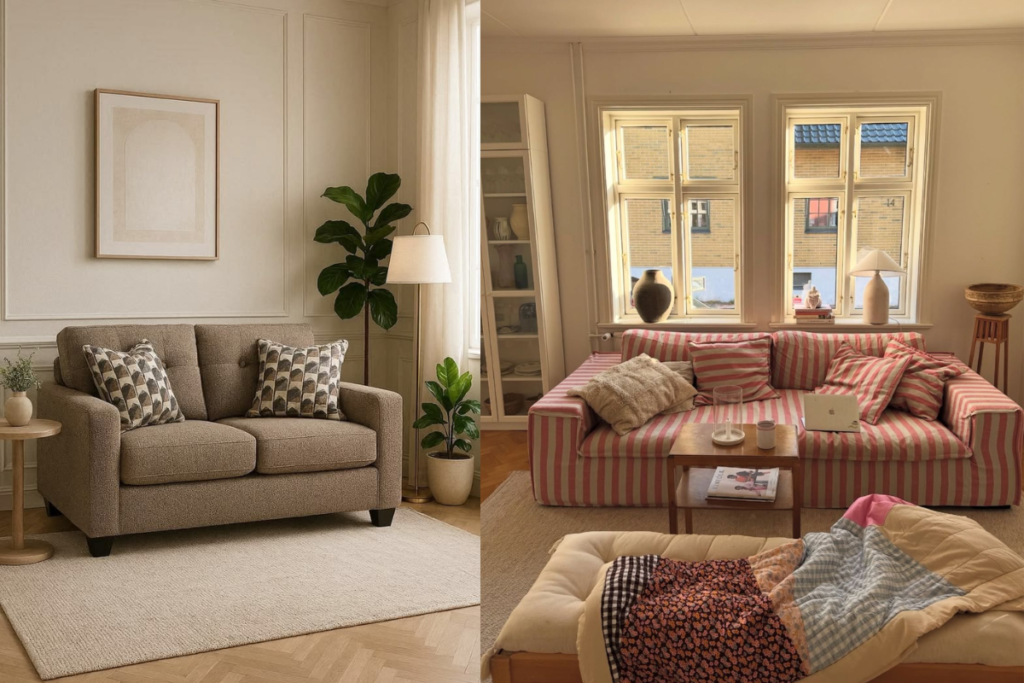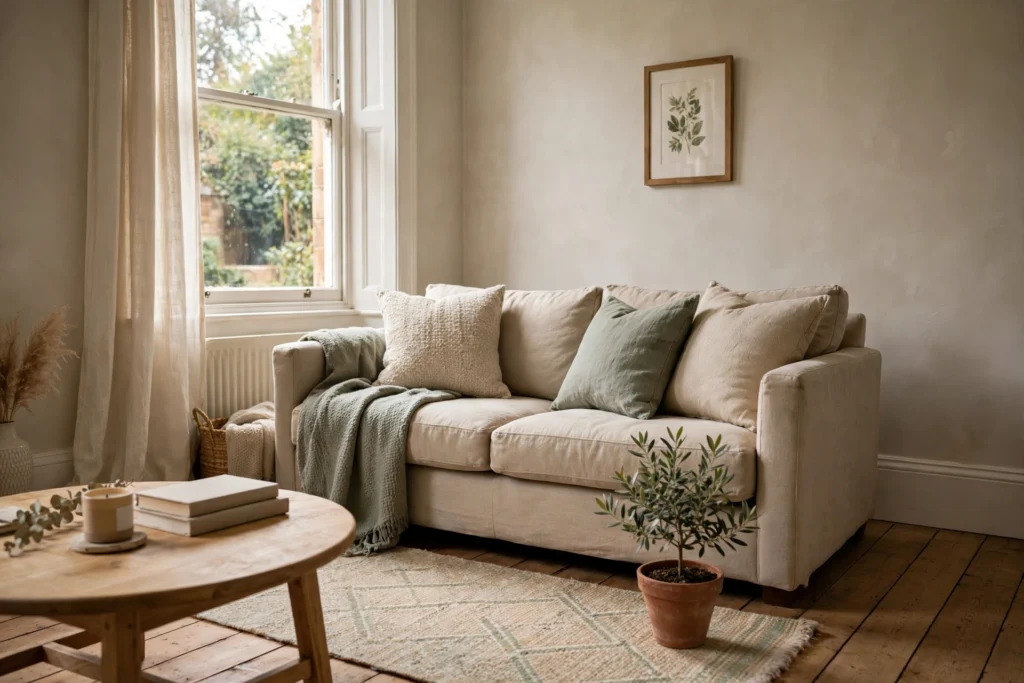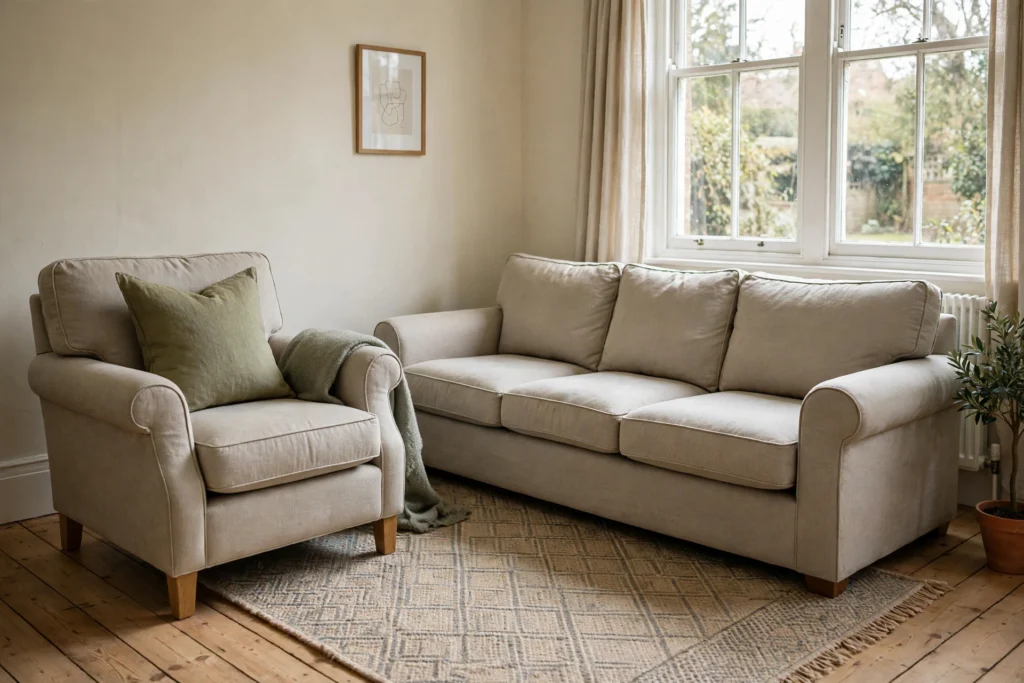
A living room chair should do more than fill an empty corner. It gives you a personal seat for reading, a balanced partner for the sofa, and extra seating when friends visit. The wrong chair can block a walkway, sit too low beside the sofa, or look fine in a photograph and feel awkward after ten minutes.
Choose chairs for living room use by first deciding how the chair will be used, then measuring the space, the sofa and the delivery route. After that, compare seat height and depth, frame and fabric, color and care. A chair that fits your body, your room and your daily routine will feel right for far longer than a chair chosen for looks alone.
This guide explains each choice in plain language. It covers chair types, sizes, comfort, small rooms, materials, colors, budgets, safety checks, placement and care, so you can compare models with confidence.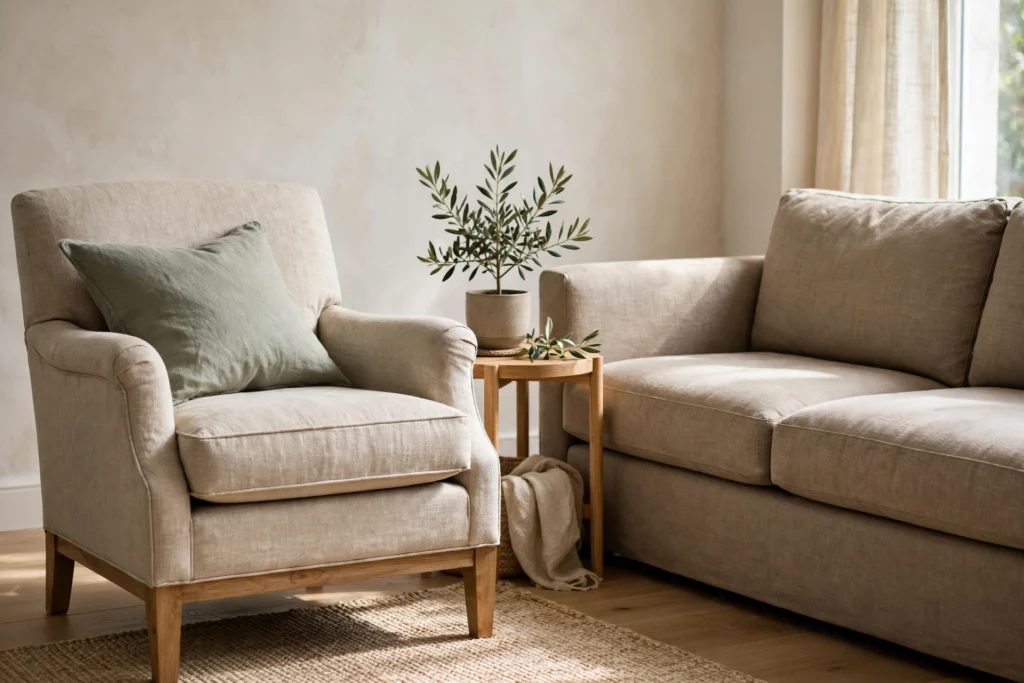
How to Choose a Living Room Chair in Five Checks
Start with these five checks before you look at colors or patterns.
- Use: Will the chair be for reading, watching television, talking with guests, or all three? A deep chair suits curling up. A shallower, firmer chair suits upright conversation.
- Space: Measure the floor area, the gap to the sofa and coffee table, and the route through doors and stairs.
- Proportion: Compare the chair with your sofa. The seat heights should be close, and the chair should not look lost beside a large sofa or crowd a small one.
- Household: Think about children, pets, spills, sunlight and how much cleaning you will really do.
- Total cost: Check the delivered price, assembly, removal of packaging, warranty and returns, not only the headline price.
If a chair fails the first three checks, a beautiful fabric will not fix it. Keep the checks in this order and shortlist only chairs that pass them.
What Types of Chairs Work in a Living Room?
Living room chairs are usually single seats, but they come in many shapes. The shape affects comfort, floor space and how formal or relaxed the room feels.
Armchairs
A standard armchair has arms, a back and a cushioned seat. It is the most flexible choice for everyday sitting, reading and conversation. Compact armchairs are often 63–80 cm wide, while larger models can be 90–119 cm wide. Always check the exact model, because the word “armchair” covers a wide range.
Accent chairs
An accent chair adds color, pattern or shape and provides extra seating. It may be slimmer, lower or more sculptural than a main armchair. Accent chairs work well opposite a sofa, in a corner, or as a pair. They are useful when you want contrast, but they still need to be comfortable for the time you will sit in them.
Tub chairs
A tub chair has a curved back that wraps around the sides. It feels enclosed and cozy, and it suits a reading corner or a small conversation area. The curved shape can make the seat feel narrower than its outer width, so sit in it, or check the inner seat width, before you buy.
Wingback chairs
A wingback chair has a high back and side “wings”. It gives good head, neck and side support and suits a drafty spot, a fireplace corner or a formal room. The high back can dominate a small room, so compare its height with the sofa and the window line.
Recliners
A recliner lets the back tilt and, in many models, raises a footrest. Manual recliners use a lever or body weight. Electric recliners use a motor and need a nearby socket. Check the fully reclined depth, the space behind the chair, and whether the mechanism is quiet and easy to use. A recliner needs more depth than its upright size suggests.
Swivel chairs
A swivel chair turns on its base. It suits an open-plan room, a corner where you want to face the sofa or the television at different times, and a small room where moving the whole chair would be awkward. Check that it can turn without hitting a wall, table or lamp.
Armless and slipper chairs
Armless chairs take less width and look light. They can be moved easily and tucked beside a sofa or table. They give less arm support, so they suit shorter sits, extra guest seating, or a room where space is tight.
Rocking chairs and lounge chairs
A rocking chair suits gentle, relaxed sitting, but it needs clear floor space behind and in front of it. A low lounge chair suits a relaxed, modern room, but it can be hard to get out of if the seat is very low. Check the seat height against your knees and the sofa.
A chair, a chaise, or an ottoman?
A chaise lounge gives a long, stretched-out seat, while an ottoman can act as a footrest, extra seat or low table. If you want leg support without a recliner, a matching footstool or ottoman can help. Make sure the combined footprint still leaves a clear walkway.
| Chair type | Best for | Watch out for |
|---|---|---|
| Standard armchair | Everyday sitting and reading | Wide arms can reduce usable seat width |
| Accent chair | Color, contrast and extra seating | Style can hide a shallow or firm seat |
| Tub chair | Cozy corners and conversation | Curved sides can feel narrow |
| Wingback | Support, drafts and formal rooms | High back can dominate a small room |
| Recliner | Television and long, relaxed sits | Reclined depth and wall clearance |
| Swivel chair | Open-plan rooms and flexible facing | Turning circle and nearby furniture |
| Armless chair | Small rooms and flexible seating | Less arm and side support |
Measure First: Size, Proportion and Delivery
Measuring takes a few minutes and prevents the most common buying mistake. A chair that looks right online can overwhelm a room or fail to fit through a door.
The measurements that matter
Record these for each shortlisted model:
- Overall width, depth and height
- Seat width, seat depth and seat height
- Arm height and arm width
- Reclined depth and height, for a recliner
- Packaged dimensions and weight, for delivery
Typical accent chairs are often about 66–81 cm wide and 71–86 cm deep, with a seat height of about 43–48 cm. Compact examples found in UK listings include a 69 cm wide petit armchair with a 41 cm seat height, and a 63 cm wide bouclé chair with a 46 cm seat height. Larger fabric armchairs in the same listings were 114–119 cm wide. These are examples, not rules. The exact chair matters more than the category name.
Seat height should usually sit close to your sofa seat height. A difference of a few centimeters is often fine, but a chair that is much lower can feel hard to stand up from, and a chair that is much higher can make your feet dangle. If you share the chair, check it for the tallest and shortest regular users.
Seat depth affects posture. A seat depth of about 50–56 cm suits many adults for relaxed sitting, while a shallower seat suits upright sitting. Leave a small gap between the back of your knee and the seat edge when you sit upright. If you like to tuck your legs up, a deeper seat and soft back cushions will feel more comfortable.
Space around the chair
Allow a clear walking route past the chair. In a small room, aim for at least 60 cm of clear walking space where people pass through. Between a chair and a coffee table, about 40–60 cm usually leaves room for legs and for putting a cup down without stretching. Between a chair and a sofa in a conversation group, about 60–90 cm often feels comfortable without shouting across the gap.
Mark the footprint on the floor with removable tape. Include the arms, the back, and any recliner movement. Walk around the outline, open nearby doors and drawers, and imagine carrying a tray through the room. A taped outline shows problems that a photograph cannot.
Proportion with the sofa
A chair should relate to the sofa in scale, not copy it exactly. If the sofa is large and deep, a tiny chair can look lost. If the sofa is compact, a wide wingback can crowd it. Compare overall height as well as width. A chair with visible legs and open space below it often looks lighter than a skirted chair of the same width.
If you are choosing between a sofa and a loveseat as the main seat, decide the main seating first. The chair should then balance that choice, not compete with it for the same visual weight.
Delivery route
Measure doors, hallways, stair turns, elevators and the final room entrance. Ask whether legs can be removed, whether the chair arrives assembled, and what the packaged size is. A chair that fits the living room may still fail at a narrow Victorian hallway or a tight stair turn. Share the smallest measurement with the retailer before you pay, especially for a large or reclining model.
Comfort: Seat, Back, Arms and Cushions
Comfort is personal, but several details can be checked before you buy.
Sit in the chair as you normally would. Rest your back against the backrest, place your feet flat on the floor, and notice whether the seat edge presses behind your knees. Lean on the arms. Do your shoulders stay relaxed? Can you change position and stand up without struggling? Spend more than a few seconds in each position you use at home.
Back support matters most for longer sits. A slightly reclined back suits reading and television. A more upright back suits conversation and shorter visits. A high back supports the head and neck. A low back can feel open and modern, but it gives less support for leaning back.
Arm height and padding affect shoulder comfort. Arms that are too high can push your shoulders up. Arms that are too low give little support for reading. If you rest a book, tablet or cup on the arm, check that the arm is wide and stable enough for normal use.
Cushion filling changes how a chair feels over time. Foam gives firm, even support and usually keeps its shape well. Fiber filling feels soft and needs regular plumping. Feather and down blends feel soft and luxurious, but they need more care and may not suit every household. A chair with a removable seat cushion is often easier to plump, turn and care for, but check whether the cover itself can be removed and washed. A removable cover is not always machine washable.
Ask about the frame and seat support. A solid hardwood or well-made engineered frame, corner joints and a sprung or webbed seat base are signs of a chair built for regular use. The listing should name the frame material and support type for the exact model. Vague words such as “premium” or “strong” do not explain construction.
Small Living Rooms: Keep the Chair Light and Useful
A small room needs a chair that gives comfort without taking over the floor.
Choose a compact width, slim arms and visible legs where possible. A chair with open space below it lets light and flooring show through, which makes the room feel less crowded. Light colors can also help, but a pale fabric needs more care in a busy household.
An armless chair, a compact tub chair or a slim swivel chair can work well. A single well-chosen chair often has more impact than two small chairs that crowd the room. If you need two seats, check whether a pair of slim chairs still leaves a clear route to the door and window.
Avoid a deep recliner, a wide wingback or a chair with a matching ottoman unless the taped outline proves there is room. A footstool that can move away when not in use is more flexible than a fixed recliner footrest in a tight room.
Place the chair where it gets good light for reading, but not where it blocks a radiator, a door or a main walkway. A corner with a small side table and a floor lamp can become a useful reading spot without using the center of the room.
Large and Open-Plan Rooms: Give the Chair Presence
A large room can swallow a small chair. Here, presence matters as much as comfort.
A larger armchair, a pair of matching chairs, or a statement accent chair can define a seating area. Two chairs facing a sofa create a clear conversation group. A swivel chair can turn between a sofa area and a dining or garden view.
Use a rug to anchor the group. The front legs of the chairs and sofa should ideally sit on the rug, or the rug should be large enough to connect them visually. A floating group, away from the walls, often works better than pushing every chair against a wall in a large room.
In an open-plan space, a chair can also mark a change in use. For example, a reading chair near a window can sit apart from the television area. Keep the styles related through color, material or leg finish, even if the chairs do not match exactly.
Materials: Fabric, Leather and Frames
Material affects look, warmth, cleaning and how long the chair stays comfortable.
Woven fabric
Woven fabric offers the widest choice of colors and patterns. It feels warm and soft, and it suits many rooms. It can show marks, dust and pet hair, so regular vacuuming helps. Performance fabrics with stain resistance suit busy family rooms, but check the exact cleaning guidance. A fabric sample at home, checked in daylight and evening light, is more reliable than a screen image.
Velvet
Velvet adds depth and a soft sheen. It can make a neutral room feel richer, especially in deep green, navy, rust or teal. Velvet shows pressure marks where it is brushed, which many people accept as part of the look. Blot spills quickly, vacuum gently, and follow the maker’s care label. Avoid harsh rubbing, which can disturb the pile.
Bouclé
Bouclé has a looped, textured surface that feels cozy and looks soft. It can hide light everyday wear, but the loops can snag on jewelry, sharp objects and pet claws. Pet hair can sit in the texture, so regular vacuuming with a soft brush attachment helps. Many makers advise gentle spot cleaning and no steam cleaning for bouclé, so check the label before using heat or moisture.
Linen and cotton blends
Linen blends feel breathable and relaxed. They suit light, airy rooms, but they can crease and may need professional cleaning. Cotton blends feel soft and familiar. Check whether the cover is removable, whether it can be washed, and how it may shrink or fade. Sunlight can fade fabrics over time, so keep chairs out of strong direct sun where possible.
Leather and faux leather
Leather is durable, easy to wipe clean, and often improves in appearance with use. It can feel cool at first and needs care to avoid drying and cracking. Faux leather is usually lower in price and easy to wipe, but it can feel less breathable and may wear differently at seams and edges. Check whether the listing means full leather, part leather, or a leather-look material. The difference matters for price and care.
Frames, legs and fillings
Wood frames feel warm and suit traditional and mid-century styles. Metal frames feel slim and modern. Check that legs are fixed firmly, that the chair does not rock, and that floor protectors suit your flooring. For a chair that will be moved often, weight matters. A heavy solid chair may be stable, but it can be hard to move for cleaning.
Fillings include foam, fiber, feather blends and pocket springs. Foam is often firmer and more even. Fiber is softer and needs plumping. Feather blends feel soft but need regular shaking and may trigger allergies for some people. Ask which filling is used in the seat and in the back, because they are often different.
Color, Pattern and Style
A chair can blend in or stand out. Both approaches work if the choice is deliberate.
Use the room’s existing colors as a starting point. A neutral sofa gives you room for a stronger chair color. A colorful sofa usually suits a calmer chair. If the room is mostly neutral, a chair in a muted green, warm rust, deep blue or soft pattern can become a focal point without overwhelming the room.
Check undertones in daylight and under evening lamps. A gray fabric can look blue beside a cool wall and warm beside wood flooring. A beige fabric can look pink or yellow beside another neutral. Hold a large sample upright, beside the sofa, rug and curtains, before you decide.
Pattern needs scale. A large pattern on a chair can dominate a small room. A small pattern can add interest without competing with a patterned rug or curtains. If the sofa already has a strong pattern, a plain chair in a related color is often easier to live with.
Texture can do the work of color. A smooth leather sofa with a nubby bouclé chair, or a flat woven sofa with a soft velvet chair, adds interest without adding another strong shade. Minimalist furniture principles can help here: limit the number of finishes, repeat one or two materials, and let the chair earn its place through shape and comfort.
Do not feel that the chair must match the sofa set. A contrasting chair often looks more considered than a matching set, especially when the two share a color, leg finish or style period. If you use two different chairs, give them one common link, such as the same leg color, a shared cushion color, or a similar height.
Budget and Total Cost: What a Chair Really Costs
Prices vary widely by size, frame, fabric and maker. Use example ranges to plan, then compare exact models on a like-for-like basis.
As examples checked on 27 October 2026, a compact UK occasional chair was listed at £129, a small printed petit armchair at £175, and a contemporary occasional chair at £269. A larger fabric armchair was listed at £299. These are single examples from different retailers and ranges, not a price promise. Prices, offers and stock change, and delivery may be extra.
A useful comparison checks:
- The exact model, size and fabric, including the fabric reference
- Whether cushions, a footstool or accessories in the photograph are included
- Delivery to your room, assembly, and packaging removal
- The warranty for frame, fabric, mechanism and cushions, and what each part covers
- Return terms, including who pays return transport and how long you have to report damage
A lower headline price can cost more if delivery, assembly or a short warranty is added later. A higher price can be better value if the frame, fabric and warranty suit daily use for many years. Divide the total cost by the years you expect to use the chair, but treat that as a planning aid, not a guarantee of lifespan.
Secondhand chairs can offer good quality at a lower price. Inspect the frame, cushions, fabric, legs and mechanism. Include transport and any cleaning or repair in the budget. For upholstered furniture, check the fire-safety label before you buy, as explained below.
Safety and Practical Checks Before You Buy
A living room chair should be safe and practical, not only attractive.
In the UK, new upholstered furniture should carry a permanent fire-safety label, often headed “CARELESSNESS CAUSES FIRE”, with a batch or identification number. The Furniture and Furnishings (Fire) (Safety) Regulations 1988 set requirements for fillings and covers, including resistance to a smoldering cigarette and, for permanent covers, a match test, with specified routes for natural-fiber covers over an interliner. Check that the label is present and ask the retailer for details if it is missing or unclear. For secondhand furniture, do not assume compliance from appearance alone.
Check the maximum user weight for the exact model. Examples in UK listings included chairs tested up to 110 kg and other models rated higher. The limit should suit the people who will use the chair, and the chair should feel stable when you sit and stand.
For electric recliners, check the socket position, cable route and what happens in a power cut. For manual recliners, check that the lever is easy to reach and the mechanism locks safely. Keep fingers, cables, rugs and small objects clear of moving parts. If a mechanism catches or feels stiff, stop and follow the maker’s guidance rather than forcing it.
For households with babies, toddlers or pets, check for sharp edges, loose buttons, long cords and small parts. A chair that rocks or swivels should not tip easily when a child climbs on it. Keep the chair stable on the floor type you have, and use floor protectors that suit wood, laminate or carpet.
Renters should check any restrictions on large furniture, delivery access and damage to floors or walls. A chair with removable legs or a smaller packaged size can help in an apartment with a narrow entrance.
Placement and Layout Ideas
Placement changes how a chair feels, even if the chair itself does not change.
Reading corner
Place the chair near a window or a good floor lamp, with a small side table within easy reach. Add a throw for cooler evenings. Keep the light behind or beside the chair, not directly in your eyes. A rug under the chair helps define the corner.
Conversation group
Angle the chair slightly toward the sofa instead of placing it in a straight line. This feels more welcoming and makes conversation easier. Keep a coffee table or side table within reach, but leave enough leg room to stand up comfortably.
Television area
Place the chair where the screen is at a comfortable height and angle. A recliner or a chair with good back support suits longer viewing. Avoid placing the chair where its back blocks a walkway to the kitchen or door.
Floating and corner layouts
Floating a chair away from the wall can create a more interesting layout in a larger room, especially with a rug and a side table. In a smaller room, a corner placement can use space that would otherwise stay empty. Check that the chair does not block a radiator, curtain movement or a cupboard door.
For more ideas on arranging the whole room, see the guide to ideas for designing a living room. Use it to test the chair against the room’s main activity, not only against a single wall.
Styling Without Overdoing It
A chair looks best when styling supports its use.
Add one cushion or throw that relates to the room, rather than covering the chair. A textured cushion can soften a smooth fabric. A plain cushion can calm a patterned chair. Change cushion covers seasonally if you like variety, but keep the chair itself easy to use.
A side table should be close enough for a cup or book, and at a height that does not force you to reach up or down too far. A floor lamp should give enough light for reading without glare. A rug should connect the chair to the sofa and table, not sit as a small island under one leg.
Keep the area around the chair clear. A chair with a pile of unused cushions, a large plant behind it and a stack of books on the seat stops being useful. Leave the seat ready to sit in.
Care and Maintenance by Material
Care starts with the maker’s label for the exact chair. Advice for one fabric can damage another, even when the fabrics look similar.
Vacuum upholstery regularly with a soft brush attachment, including seams and crevices. Deal with spills quickly by blotting, not rubbing. Rubbing can spread a mark and disturb the fabric surface. Test any cleaner in a hidden area first, if the maker allows it, and follow the cleaner’s instructions.
For velvet, brush the pile in one direction after cleaning to restore its look. For bouclé, vacuum gently and blot spills at once, and avoid steam cleaning unless the maker clearly allows it. For leather, dust with a soft cloth and use only products made for that leather type. For removable covers, check the washing label before machine washing. Some covers are spot-clean only.
Rotate and plump loose cushions regularly if the maker advises it. Check legs, fixings and recliner mechanisms from time to time. Tighten loose fixings gently and stop using a mechanism that feels damaged. Keep chairs away from strong heat and prolonged direct sunlight to help colors and materials last longer.
For care by material, always follow the maker’s own care label for your chair, because fabric type changes the cleaning method. Judge comfort and proportion by sitting in the chair where possible before buying.
Common Mistakes to Avoid
- Buying by photograph alone. A chair can look right online and feel wrong in the room. Measure, check seat dimensions, and sit in it where possible.
- Ignoring the delivery route. A chair that fits the room can fail at a doorway or stair turn.
- Choosing a seat that is too deep or too low. Comfort depends on seat height, depth and back support together.
- Matching everything. A matching set can look flat. Contrast in color or texture often feels more natural.
- Forgetting care. A pale velvet chair in a busy pet household needs a realistic cleaning plan.
- Comparing headline prices only. Delivery, assembly, warranty and returns change the true cost.
- Skipping the fire label. Check the permanent label, especially for secondhand upholstered furniture.
Before You Buy Checklist
Use this checklist for each shortlisted chair:
- Use is clear: reading, television, conversation, or a mix
- Overall, seat and reclined dimensions are recorded and checked against the room
- Taped outline leaves a clear walkway and a usable gap to the sofa and table
- Delivery route, packaged size and assembly are confirmed
- Frame, filling, fabric and care label are named for the exact model
- Color and texture have been checked in daylight and evening light
- Total price, delivery, warranty and returns are in writing
- Fire-safety label and weight limit have been checked
- The chair can be returned or exchanged if it does not fit or feel right
If a retailer cannot answer several of these points, treat that as useful information. A clear specification is part of good value.
Frequently Asked Questions
How much space should I leave around a living room chair?
Leave a clear walking route of at least 60 cm where people pass through. Allow about 40–60 cm between the chair and a coffee table for leg room, and about 60–90 cm between the chair and the sofa in a conversation group. A recliner needs extra depth when fully reclined, so check that measurement as well as the upright size.
What size chair is best for a small living room?
A compact chair, often about 63–80 cm wide with slim arms and visible legs, usually suits a small room. An armless chair or a slim swivel chair can also work. Mark the footprint with tape and check the walkway before you buy. One well-chosen chair is often better than two chairs that crowd the room.
Should a living room chair match the sofa?
No, it does not need to match. A chair should coordinate with the sofa through color, texture, leg finish or style, but contrast often looks more considered. If the sofa is neutral, a chair can add color. If the sofa is colorful, a calmer chair usually balances the room. Keep one shared element so the pairing looks intentional.
Is leather or fabric better for a living room chair?
Leather is durable and easy to wipe clean, and it often ages well, but it can feel cool and needs suitable care. Fabric offers more colors and patterns and often feels warmer, but it needs more regular vacuuming and stain care. Performance fabrics can suit busy households with children or pets. Choose by daily use and cleaning time, not by looks alone.
How much should I spend on a living room chair?
Spend according to use, construction and care, not only appearance. Example UK listings checked on 27 October 2026 included compact chairs at £129 and £175, a contemporary occasional chair at £269, and a larger fabric armchair at £299. Compare the total delivered cost, frame and fabric, warranty and returns for the exact model. A chair used every day deserves a stronger frame and clearer care guidance than an occasional guest seat.
A Practical Close
The best chair for your living room is the one that fits the room, supports the way you sit, and stays easy to live with. Measure first, test comfort in your usual sitting position, and compare materials and total cost for the exact model. A calm, well-measured choice will feel right long after the first impression fades.