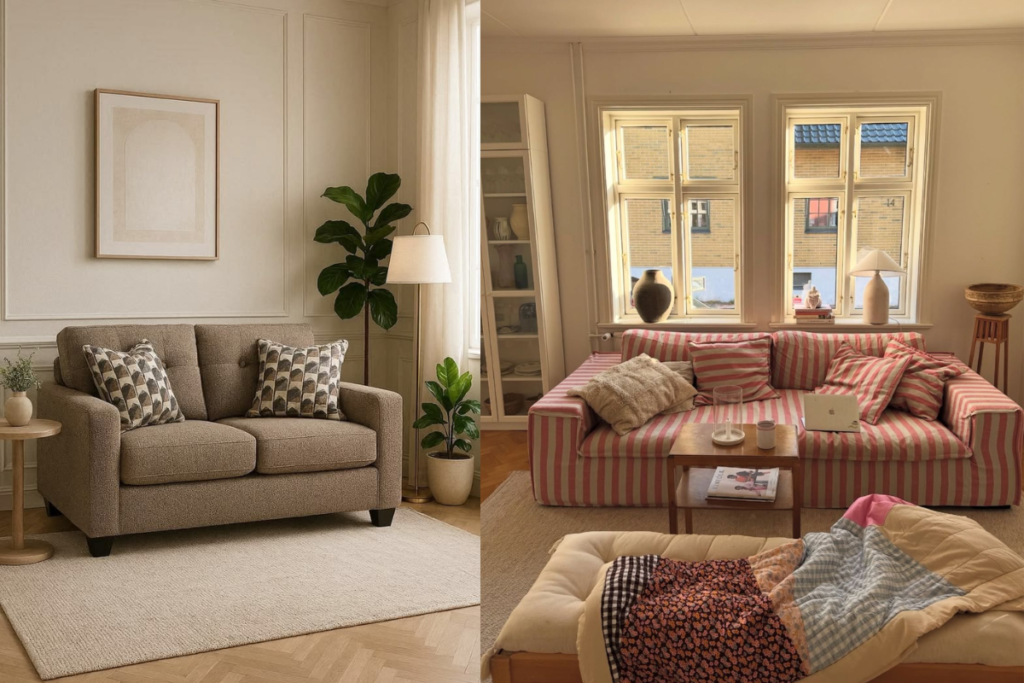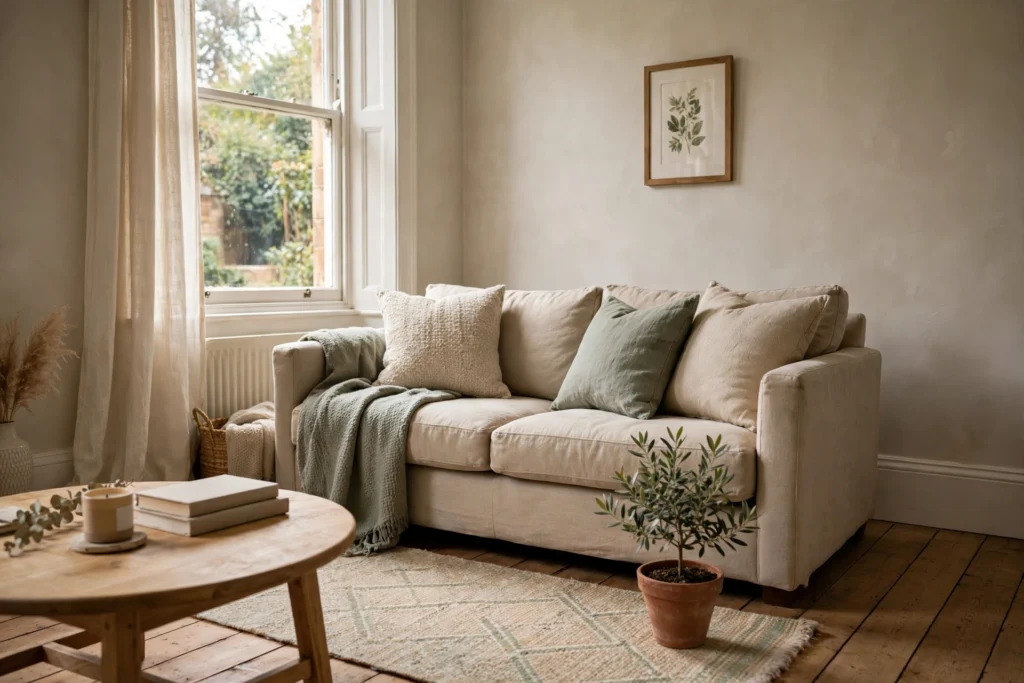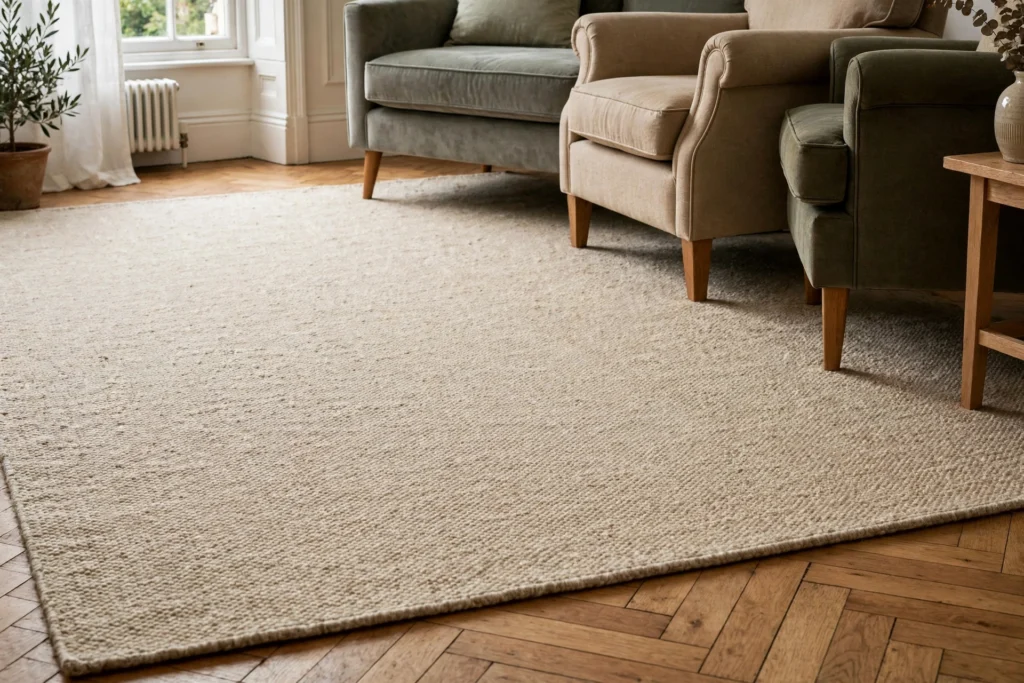
A large rug can change how a living room feels in one step. It can soften hard floors, pull scattered seating together, and make a big room feel calm rather than empty.
For most UK living rooms, choose a rug of 200 x 290 cm or larger, and make sure at least the front legs of your sofa and chairs sit on it. Leave a border of bare floor around the edges, usually 30 to 45 cm, so the room still looks like a room. That one rule solves most sizing mistakes. The rest of this guide helps you match the size to your sofa, pick a material for real daily life, and choose a colour and pattern you will still like in a few years.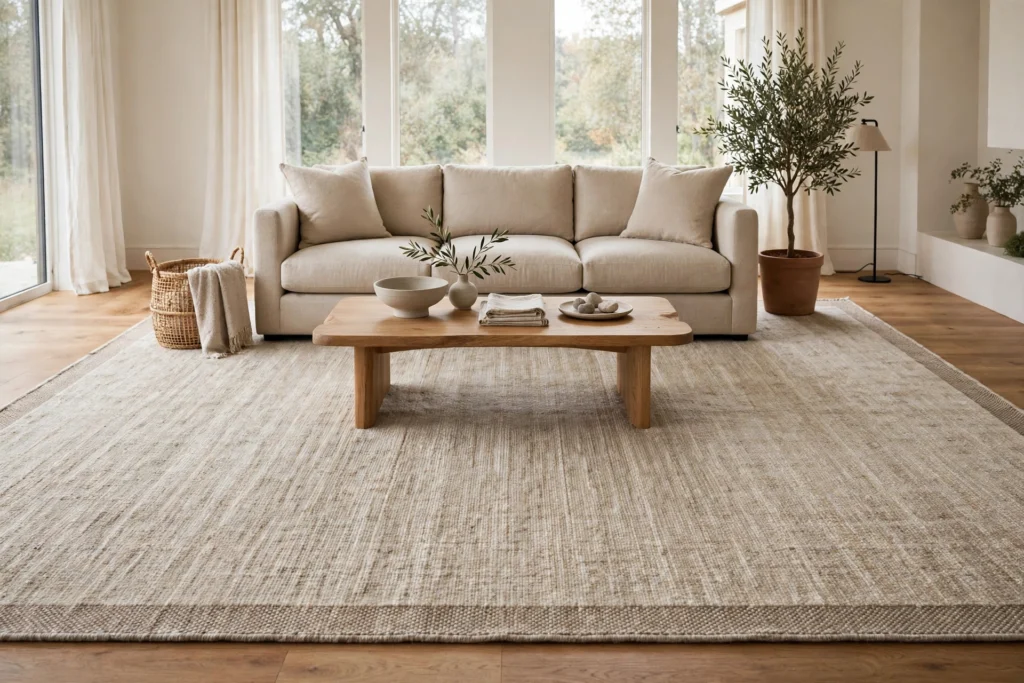
What Counts as a Large Rug?
A rug is generally called large when it measures 200 x 290 cm or bigger. Common large sizes in the UK include 200 x 290 cm, 200 x 300 cm, 240 x 330 cm, 240 x 340 cm, 280 x 360 cm and 300 x 400 cm. Smaller sizes such as 120 x 170 cm and 160 x 230 cm can work well in compact rooms, but they are not large rugs in the usual sense. They suit a small seating group, a single chair, or a coffee table zone.
Size matters more than pattern or colour at the start. A beautiful small rug in a large seating area can look lost. It can also create a practical problem. If chair legs sit half on and half off the edge, chairs can wobble, and people can catch a foot on the raised edge. A large rug gives the whole seating group one level surface to sit on.
This guide focuses on that large-size decision. It covers how to measure, how different sofa shapes change the size you need, and how to use a large rug in an open-plan room. For a broader introduction to area rugs, including smaller sizes and general placement ideas, see the guide to area rugs for the living room. The advice below builds on that general picture by dealing only with the choices that matter most when the rug itself is large.
Think first about how the room is used, not only how it looks in a photograph. A living room used every evening by a family, with children, pets, food, and muddy shoes, needs a different rug from a quiet room used mainly for reading and conversation. Foot traffic, sunlight, doorways, radiators, and the type of floor underneath all affect the choice. A large rug is a bigger commitment than a small mat. It is heavier to move, harder to clean in a home washing machine, and more costly to return if the size is wrong. That is why measuring first matters so much.
Measure First: A Simple Five-Step Method
Start with the furniture, not the rug catalogue. Place your sofa, chairs, and coffee table where you want them. Live with that layout for a day if you can. Check walking routes, door swings, and whether anyone has to step around furniture to reach a seat. The rug should support the layout you actually use.
Next, measure the seating group. Measure from the outer edge of one arm to the outer edge of the other, including any chairs you want to connect. Then measure from the front of the sofa to the front of the chairs opposite, or to the edge of the coffee table zone. Add space so at least the front legs of each seat sit on the rug. Many guides suggest adding 40 to 80 cm around the furniture group when measuring. In a smaller room, that full addition may not fit. Aim instead for a rug that extends 20 to 30 cm beyond the front legs on each side, while still leaving a border of floor at the walls.
Mark the shape on the floor. Use masking tape, string, or old sheets to outline the size you are considering. Walk around it. Sit down. Put the coffee table inside the outline and check that you can reach a drink without leaning too far. Open doors and drawers nearby. Check that the outline does not block a radiator, a fireplace hearth, or a doorway. This simple test often shows that the size you liked online feels either too tight or too dominant in the real room.
Check the floor border. As a general guide, leave 20 to 40 cm of visible flooring around the rug where the room allows. In a large room, 30 to 45 cm often looks balanced. The border frames the rug and shows off wood, laminate, tile, or vinyl flooring. If the rug touches skirting boards on every side, the room can feel as if it has a fitted carpet that does not quite fit. If the border is very wide on one side and narrow on another, centre the rug on the seating group rather than on the room walls.
Finally, measure door clearance and delivery access. A large rug arrives rolled, but it can still be long and heavy. Measure doorways, stairs, and lifts if you live in a flat. Check whether the rug will fit under a door that opens into the room. Low-pile rugs, usually around 5 to 10 mm thick, are less likely to catch on doors than deep-pile rugs. If you have underfloor heating, check the product page for suitability before you buy. Do not assume every rug is suitable.
| Room and seating group | Useful starting size | When to go larger |
|---|---|---|
| Small room, two-seater sofa and one chair | 160 x 230 cm | If the front legs will not all sit on the rug |
| Medium room, three-seater sofa and two chairs | 200 x 290 cm | If the room is open plan or the sofa is deep |
| Large room, three-seater sofa and two chairs | 240 x 340 cm | If you want all furniture legs on the rug |
| Corner sofa, small to medium | 200 x 300 cm | If both runs of the sofa need full coverage |
| Corner sofa, large, or sectional | 240 x 340 cm or 300 x 400 cm | If the seating area is wide and open |
| Two sofas facing each other | 240 x 340 cm or larger | If you want a clear frame around both sofas |
These sizes are starting points, not rules for every home. Your sofa depth, chair size, and room shape matter. A deep sofa with a chaise needs more length than a slim two-seater. A bay window or a fireplace can change where the seating group sits. Use the tape outline to test the size in your own room before you order. When in doubt, size up rather than down, because a slightly larger rug usually looks more generous than a rug that is too small.
Layouts That Work for Large Rugs
Front legs on the rug
This is the most useful layout for most UK living rooms. The front legs of the sofa and chairs sit on the rug. The back legs stay on the bare floor. The coffee table sits fully on the rug. The layout connects the seating group without needing a rug large enough to hold every leg. It works in medium rooms, and it often works in smaller rooms if you choose the largest size that still leaves a floor border.
Check that the rug extends far enough in front of the sofa. You want your feet to rest on the rug when you sit down, not on cold hard floor just beyond the edge. Check the sides too. A rug that is only as wide as the sofa can look narrow. A rug that extends 20 to 30 cm beyond each arm usually looks more balanced.
All furniture on the rug
In a large room or an open-plan space, place all the furniture on the rug. The sofa, chairs, and coffee table all sit inside the rug outline, with a small margin of rug visible around them. This creates a clear island of seating. It also helps with comfort. Every seat is on the same soft surface, and furniture is less likely to rock on an uneven edge.
This layout needs a genuinely large rug. For a three-seater sofa and two chairs, 240 x 340 cm is often the starting point. For a large corner sofa, 300 x 400 cm may be needed. Measure carefully, and leave the floor border at the walls. If the rug fills the whole floor, the room can feel heavy. A border of 30 to 45 cm usually keeps the balance right.
Coffee table only
A rug under only the coffee table can work in a very small room, or when a large rug is used as a decorative centrepiece in a very large room. In most living rooms, it is the least effective layout. The seating can look disconnected, and the rug can look like a mat placed in the middle of the floor.
If you must use this layout, keep the coffee table centred and choose a rug large enough for the table plus a margin around it. Treat it as a deliberate choice for a tight space, not as the ideal. If the room allows a larger size, move to the front-legs layout. The difference in how settled the room feels is often clear as soon as you try both outlines on the floor.
Corner sofas and sectionals
Corner sofas need careful measuring. The rug must cover the front of both runs of the sofa, not only the longest run. Place the rug so the corner of the sofa sits over the rug, with the front legs of both sections on it. For a smaller corner sofa, 200 x 300 cm is a useful minimum. For a larger corner sofa, 250 x 350 cm or 300 x 400 cm may be needed.
Sectional sofas in open-plan rooms need the same care. The rug should define the whole seating area, including any chaise section. If the rug stops halfway along the chaise, the seating group can look unfinished. Mark the outline with tape and sit in each seat. Check that no front leg hangs off the edge when someone sits down and shifts their weight.
Open-plan rooms and zoning
A large rug is one of the simplest ways to zone an open-plan room. It creates a living area without a wall. Place the rug under the main seating group, centred on the sofa and coffee table. Keep it clear of the dining area or work area nearby. A different rug, or no rug, in the next zone helps the eye read the room as separate areas that still belong together.
Avoid overlap between zones. If the living room rug runs under a dining table, chairs can catch on two edges at once. If you use two rugs in one open space, choose different textures or colours so each zone feels distinct. For example, a soft pile rug can mark the lounge, while a flatweave rug can mark a work corner. Leave a clear strip of bare floor between zones where possible. That strip acts as a path and keeps the room from feeling cluttered.
Layering can help in an open-plan room, but keep it simple. Start with a large, plain base rug in a neutral tone. Add a smaller, more patterned rug on top, centred under the coffee table. Leave 20 to 30 cm of the base rug visible around the top rug. Use a non-slip underlay between the layers if the top rug moves. Layering works best when the base rug is flat and the top rug is not too thick. Too many layers can create a trip hazard at the edges, especially for children, older visitors, or anyone with limited mobility.
For wider ideas on how seating, colour, and layout work together, the guide to ideas for designing a living room is a useful companion to this sizing advice. Use it to test how a large rug fits with your existing furniture, rather than letting the rug dictate every other choice.
Materials: Choose for Daily Life, Not Only for Looks
Material affects comfort, cleaning, durability, and cost. The right material depends on who uses the room, whether pets live in the home, how much sunlight the rug receives, and how much time you want to spend on care.
Wool is a strong choice for many living rooms. It feels soft, recovers well from foot traffic, and has natural resistance to dirt and marks. Wool rugs can shed at first, especially new rugs. Regular vacuuming usually reduces shedding over time. Wool needs gentle care. Vacuum with suction only, or with the beater bar switched off, where possible. Blot spills at once. Do not soak a wool rug, and check the care label before using any cleaning product. Professional cleaning is often recommended every 12 to 18 months for normal use, and more often in homes with pets or children. Wool is usually at the higher end of the price range for large rugs.
Polypropylene and polyester rugs suit busy family rooms. They are hard wearing, resist stains, and are often easier to clean than natural fibres. Low-pile synthetic rugs are practical under dining chairs and in homes with pets, because fur, crumbs, and mud are easier to remove. The feel is less soft than wool, and the look can be less rich in close detail. For a large rug that will face daily spills, that trade-off is often worth it. Check whether the rug is washable, and if so, whether your washing machine can take its size and weight. Many large rugs are too big for a home machine, even if the material itself is washable.
Cotton rugs are light, soft, and often affordable. They suit relaxed rooms and low-traffic areas. Cotton is less durable than wool in a busy living room, and it can show wear sooner. Smaller cotton rugs are often machine washable. A large cotton rug may still need spot cleaning or professional cleaning. Cotton is a useful choice if you want a soft, casual feel and you accept that it may need replacing sooner than a wool rug.
Jute, sisal, and seagrass bring texture and a natural look. They suit relaxed, coastal, or rustic rooms. They are firm underfoot rather than soft. Jute is best in low-traffic areas, because it can absorb liquid and stain. Sisal and seagrass are more durable and handle foot traffic better, but they are still not soft. They can be hard on bare feet, and they can catch on pet claws. If you like the look but want comfort, consider layering a smaller soft rug on top of a large jute base, with a non-slip layer between them.
Viscose and silk-look rugs look elegant. They have a soft sheen and fine detail. They are best in low-traffic rooms. Viscose can stain easily with water, and it is not a good choice for a busy family room, a home with young children, or a room where drinks are often carried across the rug. Professional cleaning is usually needed. If you love the look, reserve it for a quiet sitting area, not the main family seating group.
| Material | Best for | Watch out for |
|---|---|---|
| Wool | Comfort, durability, everyday living rooms | Shedding at first, gentle cleaning, higher price |
| Polypropylene or polyester | Children, pets, spills, high traffic | Less soft feel, check washing and heat guidance |
| Cotton | Soft, casual, low-traffic rooms | Wears faster, large sizes may not fit a home machine |
| Jute | Quiet rooms, natural texture, layering base | Firm feel, absorbs liquid, not ideal for pets |
| Sisal or seagrass | High traffic, texture, natural look | Firm feel, can catch claws, needs careful spot cleaning |
| Viscose or silk-look | Low-traffic, decorative rooms | Stains easily, professional cleaning, avoid busy rooms |
Pile height also matters. Pile is the length of the fibres standing up from the backing. Low-pile rugs, around 5 to 10 mm, are easier to vacuum, easier to place under doors, and less likely to trap crumbs. They suit busy rooms and homes with wheeled toys or mobility aids. Medium-pile rugs feel softer and warmer. Deep-pile or shaggy rugs feel luxurious under bare feet, but they need more thorough vacuuming, they can trap dust and pet hair, and they can make doors stick. If a rug will sit beside a door, measure the gap under the door before choosing a deep pile.
Underlay is worth budgeting for. A non-slip underlay helps a large rug stay in place on wood, laminate, tile, and vinyl floors. It adds a little cushioning, protects the floor from grit under the rug, and can help the rug lie flat. Some rugs have a non-slip backing built in. Others need a separate underlay. Check the product details and the flooring guidance. If you have a rug on carpet, the rules change. A thick rug on a soft carpet can feel unstable. For that case, read the guide to putting a rug on carpet before you buy, and check whether an underlay made for carpet is recommended.
If your floor is cork, check compatibility too. Cork is softer than wood or tile, and a heavy rug with a rough backing could mark it over time. The guide to cork flooring explains how cork behaves and what to check before placing heavy furniture and rugs on it. In general, lift rather than drag a large rug across any hard floor, and clean the floor underneath from time to time so grit does not scratch the surface.
Colour, Pattern, and Your Sofa
Colour is personal, but a few practical rules help. Start with the largest fixed elements in the room: flooring, sofa, curtains, and wall colour. The rug should relate to them, not fight them. It does not need to match any one item exactly. In fact, an exact match can look flat. A rug that picks up one tone from the sofa, one from the floor, and one accent colour often looks more natural.
A lighter rug than the sofa can make a small room feel brighter and more open. It can also make a dark sofa stand out. The trade-off is maintenance. Light rugs show marks, pet hair, and spills more clearly. In a family home, a light rug with a subtle pattern, or a washable rug, may be more practical than a plain pale rug. A darker rug hides dirt better and can ground a light room. It can also make a small room feel smaller if the walls and furniture are also dark. Keep the rest of the room light if you choose a dark rug in a compact space.
Pattern scale matters as much as colour. A large pattern can suit a large room and a large rug, because there is enough space for the design to repeat. In a small room, a large bold pattern can overwhelm the space. A small, subtle pattern is often safer in a tight room. Pattern also hides marks better than a plain surface. A heathered or lightly patterned rug can disguise pet hair and small spills between cleans. A plain rug shows every crumb, but it also gives you a calm base for patterned cushions and artwork.
Think about your sofa colour before you choose. A grey sofa in a grey room can look flat if the rug is also cool grey. Warm wood, cream textiles, and a rug with warm undertones can balance it. A brown sofa can look heavy if the rug is also dark brown. A lighter rug with a warm background can create separation. A strong sofa colour, such as teal, mustard, or burgundy, often works best with a quieter rug. Let the sofa be the main colour statement, and use the rug to connect it to the floor and walls. For help judging whether a sofa colour itself is making the room feel dated, see the guide to outdated living room couch colours. That guide shows how context, light, and surrounding finishes change how a colour reads.
Test colour in your own light. A rug can look different in a shop, in a photograph, and in your living room. Morning light, evening lamps, and north-facing windows all change colour. Order samples where possible. Place a large sample on the floor, beside the sofa and flooring, and look at it at different times of day. Check it under your usual evening lighting too. If samples are not available, check the return policy before you order. A large rug is costly to return, so knowing the return window, collection method, and any return charge matters.
Avoid choosing a rug only because it is fashionable this season. A large rug is a long-term purchase. Simple, well-balanced colours and patterns age better than a very bold trend. You can add trend colours with cushions, throws, and artwork, which are easier and cheaper to change. The rug should still work if you repaint the walls or change the cushions next year.
Budget, Shopping Checks, and Delivery
Set a total budget, not only a rug price. Include underlay, delivery, and any return cost if the size is wrong. Large rugs are heavy. Delivery may need two people, and returning a large rug may need a courier collection. Check those details before you order, especially if you live upstairs or in a flat with narrow stairs.
As a broad shopping guide, based on UK guides reviewed in October 2026, large synthetic living-room rugs often fall in the region of £60 to £250 or more, depending on size and construction. Large wool rugs, hand-finished rugs, and designer-led rugs often cost £200 and above, and can cost much more. Small rugs and runners are cheaper, but they are not a useful comparison for a large rug. These are broad bands, not a promise of a current price. Always check the live product listing for the exact size you want, because one design can vary a great deal by dimension. A sale price for a small size does not tell you the price of the large size.
Compare like with like. Check size, fibre, pile height, backing, and whether underlay is included. A cheaper rug that needs a separate underlay, professional cleaning, and early replacement may cost more over time than a better-made rug. Check the care label. If the label says professional cleaning only, add that cost to your thinking. If the rug is washable, check the maximum wash size and whether it can be dried flat without damage.
Before you buy, work through these checks. First, confirm the exact size in centimetres, not only a size name such as large or extra large. Size names vary between retailers. Second, confirm the fibre mix. A rug described as wool may be a wool blend. The blend affects feel, cleaning, and durability. Third, confirm pile height and total thickness, including any backing. Fourth, check door clearance, stair access, and whether the rug can be carried into the room. Fifth, check the return policy, including the time limit, whether collection is offered, and whether the rug must be unused and in its original packaging.
Ask for samples when they are offered. A sample helps you judge colour, texture, and pile, but it does not show the full pattern repeat. Ask the retailer how the pattern repeats across a large size. Some patterns look balanced in a small sample and busy across 300 cm. If you buy online, read the product questions and reviews for comments on shedding, curling edges, and whether the rug lies flat after unrolling. New rugs often need a day or two to relax after unrolling. Corners that curl can sometimes be helped by folding them under for a day, but if curling persists, contact the retailer rather than forcing the rug flat with heavy furniture on the edge.
Living With a Large Rug: Care, Pets, Children, and Renters
A simple routine keeps a large rug looking good. Vacuum once or twice a week, more often in high-traffic areas and homes with pets. Vacuum in the direction of the pile where possible. Use suction only for wool and delicate rugs, or switch off a rotating beater bar if your vacuum allows it. Vacuum both sides from time to time, if the rug is light enough to lift safely with help. Clean the floor underneath as well, so grit does not scratch hard floors.
Rotate the rug every few months, or every six months in a quiet room. Rotation evens out wear and fading from sunlight. It also helps if one side receives more foot traffic than the other. If the rug is very large and heavy, ask for help. Do not drag it across the floor. Lift it, or roll it carefully, to avoid marking the floor and damaging the rug edge.
Treat spills at once. Blot with a clean white cloth. Do not rub, because rubbing can spread the mark and damage fibres. Work from the outside of the spill towards the centre. Use only a mild detergent mixed with lukewarm or cool water, and only if the care label allows it. Test any cleaning solution on a hidden corner first. Check for colour transfer onto the cloth. If colour leaks, stop and seek professional advice. For silk, viscose, and sheepskin rugs, professional cleaning is usually the safe choice. Do not use bleach, ammonia, or strong chemicals unless the care label clearly allows them.
Pets and children change the choice. Low-pile, tightly woven rugs are easier to clean and less likely to catch claws. Patterned rugs hide fur and small marks better than plain pale rugs. Jute and sisal can absorb liquid, so they are less forgiving for pet accidents. Loose loops can catch claws and pull. Washable rugs can help, but check the size limit for washing. A large rug may be washable in theory and too large for a home machine in practice. Keep a spot-cleaning kit nearby: clean cloths, a mild wool-safe or fibre-safe cleaner if the label allows it, and a small bowl. Acting quickly matters more than using a strong product.
Renters should check the tenancy agreement and the flooring before buying a large rug. A rug can protect flooring, but a heavy rug, a rough backing, or trapped grit can also mark it. Use a suitable underlay, and lift the rug to clean underneath. Avoid rugs that need adhesive pads on floors where adhesive could damage the finish. Keep the original flooring visible at the edges where possible, so the room still reads as the landlord intended. If you need to return the flat to its original state, a rug you can roll up and take with you is often a better choice than a very large, heavy rug that is hard to move.
Sunlight causes fading over time. Direct sun can fade one side of a rug faster than the other. Use curtains or blinds during the brightest part of the day if the rug sits in direct sun. Rotation helps, but it does not prevent fading entirely. If fading is a concern, choose a rug with a colour and pattern that will still look good with a little softening. Avoid placing a valuable rug in front of a south-facing patio door without sun protection if the care guidance warns against it.
Common Mistakes to Avoid
The most common mistake is buying too small. A rug that floats between the furniture, touching nothing, makes the room look disconnected. It also creates a trip edge. If you are torn between two sizes, the larger size is usually the safer choice, as long as it still leaves a floor border.
The second mistake is buying for looks alone. A delicate rug in a busy family room will show wear quickly. A deep-pile rug beside a door that sticks will annoy you every day. A rug that cannot be cleaned in a way that suits your home will become a worry rather than a pleasure. Match material and pile to daily life first, then choose colour and pattern.
The third mistake is ignoring the floor underneath. A rug on a smooth floor without a non-slip underlay can slide. A rug on carpet without the right underlay can feel unstable. A rug on cork, vinyl, or underfloor heating needs a compatibility check. The floor type is part of the purchase decision, not an afterthought.
The fourth mistake is forgetting delivery and returns. A large rug may not fit up the stairs, through a narrow hallway, or under a door. It may need two people to carry it. Returning it may cost money and need a courier. Measure access routes before you order, and read the return terms.
The fifth mistake is choosing a pattern that fights the room. A bold pattern can be beautiful, but it needs space and calm surroundings. If the sofa, curtains, and artwork are already patterned, a plain or subtly textured rug often works better. If the room is mostly plain, a patterned rug can become the main feature. Decide which item should lead, and let the others support it.
Three Example Rooms
These examples are illustrations, not rules. Use them to test your own measurements.
For example, imagine a small flat living room measuring about 3 metres by 3.5 metres, with a two-seater sofa and one armchair. A 160 x 230 cm rug, placed lengthways, may work if the front legs of both seats sit on it. Leave a border of floor at the walls. A low-pile rug in a light, subtle pattern can help the room feel open. A deep-pile rug that fills the whole floor may make the room feel crowded.
Suppose a medium living room measures about 4 metres by 5 metres, with a three-seater sofa, two armchairs, and a coffee table. A 200 x 290 cm rug is a useful starting point. Place the front legs of all seats on the rug. Leave 30 to 45 cm of floor at the walls where possible. A wool or low-pile synthetic rug can suit daily family use, depending on cleaning needs.
Imagine an open-plan room measuring about 5 metres by 6 metres, with a large corner sofa and a dining table nearby. A 240 x 340 cm or 300 x 400 cm rug can define the seating zone. Place the whole seating group on the rug, and keep the rug clear of the dining chairs. Use a different texture or colour for the dining zone, or leave that zone bare, so the two areas read clearly. A large rug here also helps soften sound in a hard-floored open space.
In each example, the tape outline test matters more than the example size. Your sofa depth, chair width, and door positions change the answer. Measure, mark, sit, and walk before you buy.
Frequently Asked Questions
What size is considered a large rug for a living room?
A large rug is usually 200 x 290 cm or bigger. For a medium living room with a three-seater sofa and two chairs, 200 x 290 cm is a useful starting point. For a large or open-plan room, 240 x 340 cm or 300 x 400 cm may be needed. The right size depends on your sofa, chairs, and room shape, so test the outline on the floor before you order.
Should a large rug go under the sofa?
In most cases, yes. At least the front legs of the sofa and chairs should sit on the rug. In a large room, all the furniture can sit on the rug. That layout anchors the seating group, stops chairs rocking on an edge, and makes the room feel settled. A rug that sits only under the coffee table is usually less effective, except in a very small room.
Will a large rug make a small living room look smaller?
Not if it is sized well. A large rug that connects the seating group and leaves a border of bare floor can make a small room feel more open and intentional. A rug that is too small, floating between furniture, can make the room feel cluttered and smaller. Choose the largest size that still leaves a visible floor border, and consider a lighter colour or a subtle pattern.
What is the best material for a large living room rug with children or pets?
Low-pile wool, polypropylene, or polyester rugs are often practical choices. Wool feels soft and recovers well, but needs gentle care. Polypropylene and polyester resist stains and are easier to clean. A patterned design can hide fur and small marks. Avoid delicate viscose and loose-loop rugs in busy homes, and check the care label before you buy.
How do I stop a large rug sliding on a hard floor?
Use a non-slip underlay made for your floor type, or choose a rug with a non-slip backing. Make sure the underlay is the right size for the rug, and that it does not show at the edges. Clean the floor underneath from time to time, and check that furniture legs sit firmly on the rug. If the rug still moves, check whether the underlay is worn, dirty, or the wrong type for the floor.
A Practical Close
Start with the tape outline. Choose the largest size that fits your seating group and still leaves a border of floor. Match the material to daily life, not only to a photograph. Test the colour in your own light, and check delivery, returns, and care before you order.
A large rug for a living room should do three jobs at once. It should anchor the furniture, feel good underfoot, and make the room easier to live in. When size, material, and layout all suit the room, the rug stops being a decoration on the floor and becomes part of how the room works.